

Category: Cultures
-
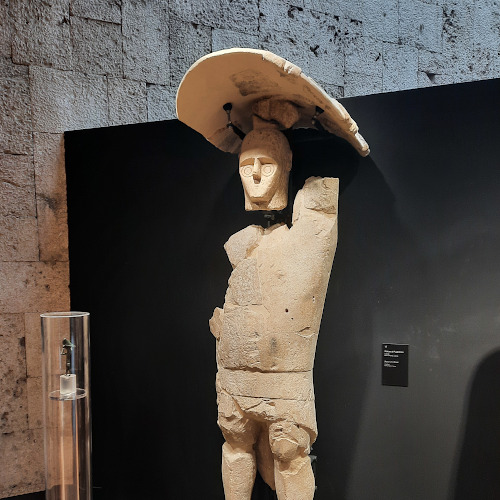
The Giants of Mont’e Prama, guardians of the Nuragic civilisation
The mistral sweeps relentlessly across the barren hill of Mont’e Prama. A gentle slope descends into the valley, while the lagoon of Cabras shimmers in the distance. The landscape is dotted with dwarf palms, which explain the curious name of the place, located in west-central Sardinia. In this corner of the Sinis Peninsula, a sublime…
-
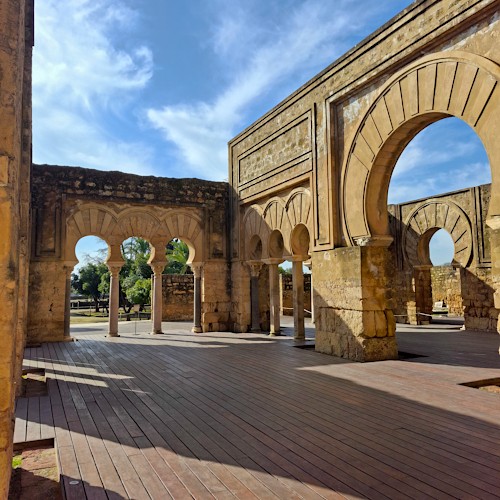
Madinat al-Zahra, the legendary shining city of Islam in Al-Andalus
Like a tale whispered by the wind or a fleeting dream upon waking, the beauty of Madinat al-Zahra, the legendary “shining city” of Islam in Andalusia, was ethereal. Later generations of poets remembered this magnificent place for its boundless wealth and sumptuous palaces adorned with fountains and gardens. From here the Umayyad ruler Abd al-Rahman…
-

Gadara, a wonderful Hellenistic city in the Middle East
Northern Jordan is a rugged land, dominated by barren hills, marked by blackish soil and the hardness of volcanic basalt. It is a frontier place where peoples and armies have moved, along which history has marked a deep groove. From here one peers beyond, towards Syria, Israel and Lebanon, one observes in silence that land,…
-
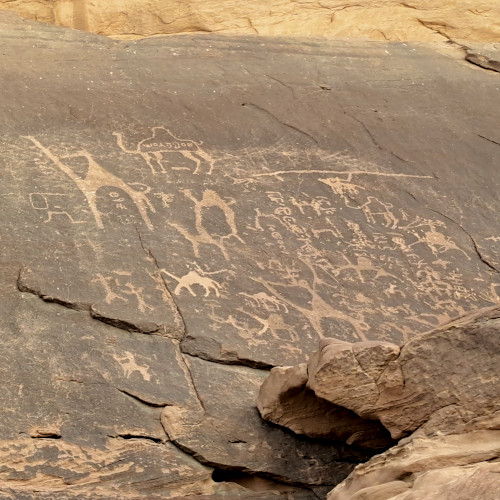
The petroglyphs of Wadi Rum, signs and images in the desert
The landscape of Wadi Rum is one of the most incredible in the world. An extraordinary wonder, made sublime by its monumental rock castles that nature created millions of years ago. An immense river once carved out the valley. The wind and weather have patiently sculpted these evocative granite and sandstone structures. Imperfect arches, pinnacles…
-

The giants’ graves, on the threshold of the afterlife
In Sardinia, there was a place for the living and a place for those who were no longer living, laid to rest but ready to be reborn beyond the stone threshold of the tomb. The Nuragic people believed that existence continued in the afterlife as it did in the known world. Thus, they conceived a…
-

Nuraghes and sacred springs, the architecture of Nuragic society
Stone upon stone, earth and sky, and then the tranquility of the countryside, the grace of nature that welcomes the towers built by man. As if marked by an archaic rhythm of drums, the Sardinian landscape was changing, being shaped according to a higher, rational order. After all, was this not the germination of the…
-
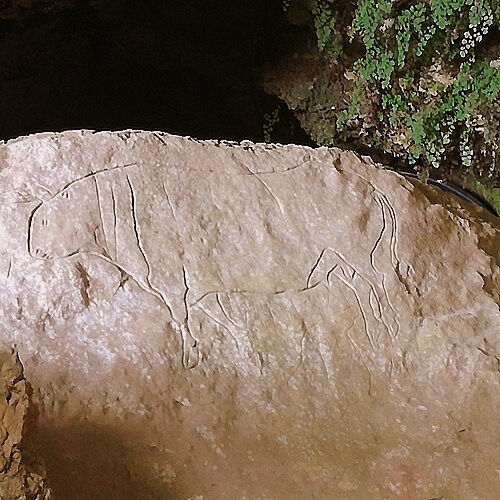
Rites and graffiti from prehistory: the Romito Cave
In the rugged countryside of Papasidero, within what is now the Pollino National Park, archaeologists uncovered a cave entrance in 1961 that had long been concealed beneath dense vegetation and forgotten for millennia. The site, later named Romito Cave, opened onto a narrow, dark passage carved primarily into limestone and concealed an extraordinary archaeological treasure.…
-

The strange glyphs of the rongorongo
Few times throughout history a form of writing originated ex novo, without deriving from systems already in use1. This is the case, for instance, with the ancient Sumerian cuneiform or some pre-Columbian systems from Central America. Such a rare occurrence also seems to concern a very special writing that no scholar still could decipher: the…
-

The Roman monuments of Nîmes, an Augustan colony in Gaul
Nemausus, the ancient city of Nîmes, with its magnificent Roman monuments, stood along the Via Domitia, an important road that ran from Turin to Iberia through the Rhône Valley. According to a legend handed down by Parthenius of Nicaea, the eponymous hero Nemaus, son of Hercules, was the founder of the settlement1. However, it is…
-

The bronze statuettes and the identity of Nuragic people
The wide fields looking westward, and the towers of the nuraghes like peaks of a barren hilly landscape. Never domed nor concealed, the stone peered over the vivid swarming of men. Some adorned with shining armaments and round shields, fierce warriors with horned helmets resting on their foreheads, placed to guard the territories where the…