The mistral sweeps relentlessly across the barren hill of Mont’e Prama. A gentle slope descends into the valley, while the lagoon of Cabras shimmers in the distance. The landscape is dotted with dwarf palms, which explain the curious name of the place, located in west-central Sardinia. In this corner of the Sinis Peninsula, a sublime stage for Nuragic art and culture, the Giants once stood: the mysterious final act of the civilization that shaped the island for fifteen hundred years. Warriors, archers and boxers carved in stone, they were ancient guardians of the threshold between past and future. Before the Giants of Mont’e Prama lies the long history of a land in constant transformation. At the time of their creation, the ancient Sardinians no longer built nuraghes for at least three centuries. These great stone towers, raised by their ancestors, now held only symbolic and ideological significance.
Mont’e Prama represents the high point of the Nuragic civilisation at a time of profound political and social change. In the Sinis Peninsula, a thriving centre of maritime trade had developed. Iron extracted from the Montiferru ore deposits, just north of the region, was exported alongside finely crafted metal artefacts, including bronze figurines and votive model boats, which circulated along the principal trade routes of the Mediterranean. Sinis thus served as a vital link between the sea and the Sardinian interior. The River Tirso carried some of the island’s most valuable commodities inland and back towards the coast. We know that merchants from the eastern Mediterranean regularly frequented these shores. Among them were the Phoenicians, who from the late ninth century BC established small trading settlements in the area in search of raw materials and valuable goods.

The Discovery of the Giants of Mont’e Prama and the Archaeological Investigations
On 28 March 1974, while a field on the Mont’e Prama ridge was being ploughed, hundreds of sculptural fragments unexpectedly emerged from the soil. The discovery immediately attracted considerable interest, and archaeologists soon recognised the stones as the remains of large free-standing statues dating to the Late Nuragic period (10th–7th centuries BC). Over the following years, several excavation campaigns were conducted at the site where these “Giants” had been unearthed1. In 1975, Alessandro Bedini identified a necropolis comprising individual burials dating to three phases of use. The earliest graves consisted of simple shaft burials covered by small stone cairns. A second group consisted of pseudo-cist tombs, sealed with irregular slabs. The most recent burials were marked by neatly aligned square stone covers. Dating to the Early Iron Age, these graves formed a funerary avenue along which archaeologists recovered further sculptural fragments, including a carved foot.
Later Excavations
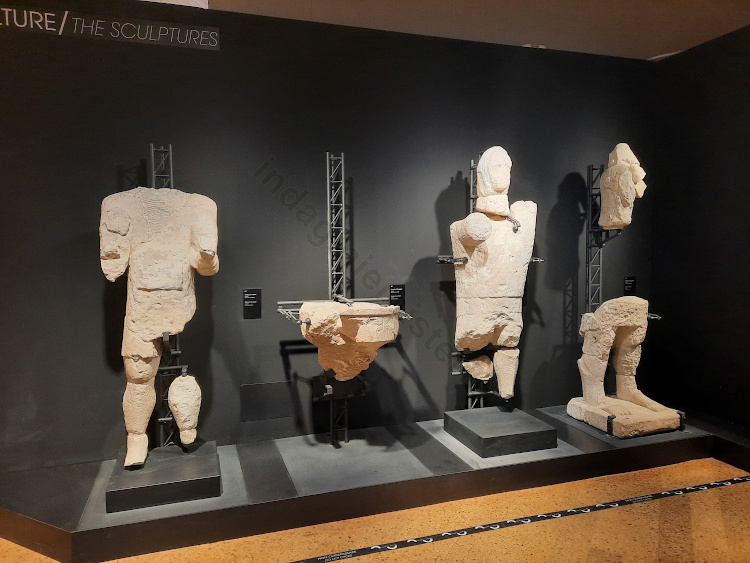
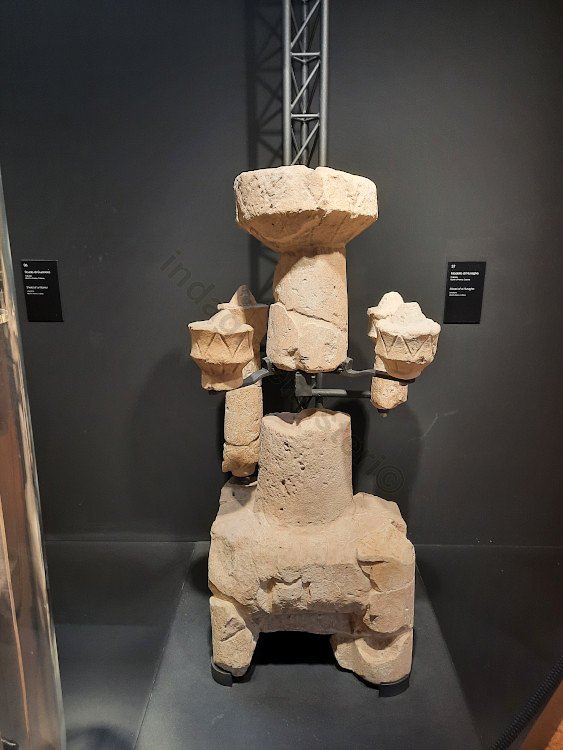
Giovanni Lilliu undertook further excavation campaigns from 1977 onwards, followed by Carlo Tronchetti and Maria Luisa Ferrarese Ceruti. Their investigations uncovered additional statues, revealing a new section of the necropolis distinguished by a sequence of sandstone cover slabs. In 1979, Carlo Tronchetti demonstrated that someone had deliberately destroyed the Giants. The statues had been systematically broken apart and shattered with chisels. Their fragments were later heaped together in the second half of the 4th century BC in a dumping area. Mixed among the debris were several sacred betyls and limestone models of nuraghes2. This period coincides with the earliest evidence for the arrival of Punic communities in Sardinia. Archaeologists have suggested that the Carthaginians intentionally destroyed the statues – “great warriors, deified and revered by all the Nuragic peoples of Sardinia”, as Giovanni Lilliu described them3 – perhaps as a demonstration of their authority over the region.
Between 2014 and 2016, new excavations promoted by the Superintendency of Archaeology of Cagliari and the University of Sassari, and directed by Alessandro Usai, Raimondo Zucca, Paolo Bernardini and their colleagues, brought to light eight circular shaft tombs arranged in orderly rows and dating to the end of the ninth century BC. These are the earliest burials so far identified within the Mont’e Prama complex. Unlike the collective Giants’ Graves of the Bronze Age, each grave contained a single inhumation. This reflects the profound social changes that transformed Nuragic society between the Final Bronze Age and the Early Iron Age. Moreover, it points to the emergence of a new ruling aristocracy. Excavations at Mont’e Prama are still ongoing. As recently as May 2022, archaeologists recovered two further giant statues from the site4.
The Necropolis of Mont’e Prama
The necropolis of Mont’e Prama is the largest Early Iron Age burial ground in Sardinia. It was a vast monumental cemetery comprising at least 150 individual graves dating from the 13th to the 4th century BC5. Only modest grave goods accompanied the deceased, who were predominantly males between the ages of thirteen and fifty. Tomb 25, excavated by Carlo Tronchetti, contained a necklace with bronze pendants and a steatite scaraboid. Tombs 24, 27 and 29 yielded only a few glass-paste beads6. The scarcity of grave goods may reflect the legacy of the earlier Giants’ Graves, where the deceased were likewise not identified through personal belongings. During the 8th century BC, ceremonial structures, probably associated with the necropolis, were erected west of the burial area. A boundary wall enclosed the complex defining the sacred precinct, or temenos, as demonstrated by the discovery of sandstone blocks belonging to the enclosure.
Because deliberate destruction reduced the Giants to fragments later discarded near the graves, it is impossible to determine with certainty where they originally stood. The deposit appeared completely disordered, and archaeologists sometimes found fragments of the same statue many metres apart. It is therefore possible that some of the sculptures originally stood against the retaining wall of the temenos, using it as a monumental backdrop, perhaps flanking the entrance to the burial ground. The fact that not all of the statues could have stood independently, lacking the structural support required to remain upright, supports this hypothesis. Even so, it is equally plausible that many of the Giants once lined the funerary avenue leading through the necropolis.
The Enigmatic Giants of Mont’e Prama
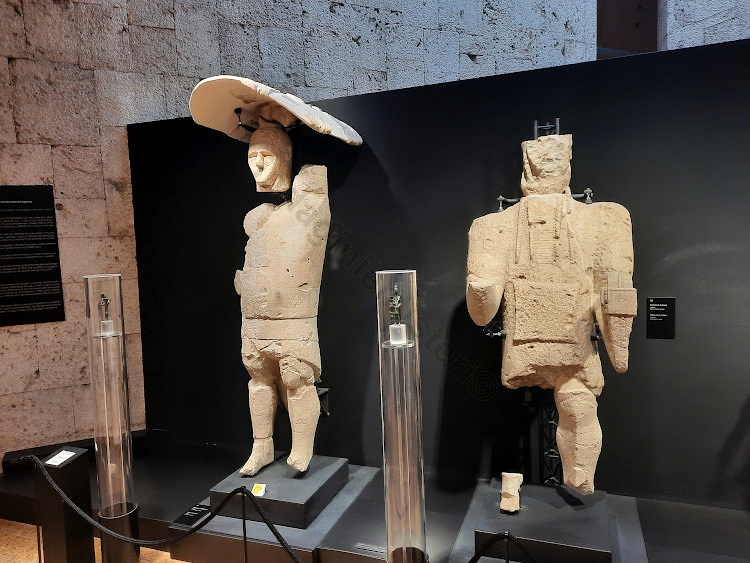
The largest sculptural complex ever created in ancient Sardinia once stood at Mont’e Prama, overlooking the necropolis. It is also among the most remarkable monumental sculpture groups in the ancient Mediterranean. Archaeologists have recovered more than 5,000 limestone fragments belonging to around forty free-standing anthropomorphic statues. Some of them reached a height of two and a half metres. The Giants were carved from limestone quarried in the Montiferru region. It is likely that the rough blocks were first shaped at the quarry before being transported by cart to Mont’e Prama, where they were finished and polished with metal tools7. We also know that the statues were originally painted, as traces of red and black pigments have survived on several fragments8.
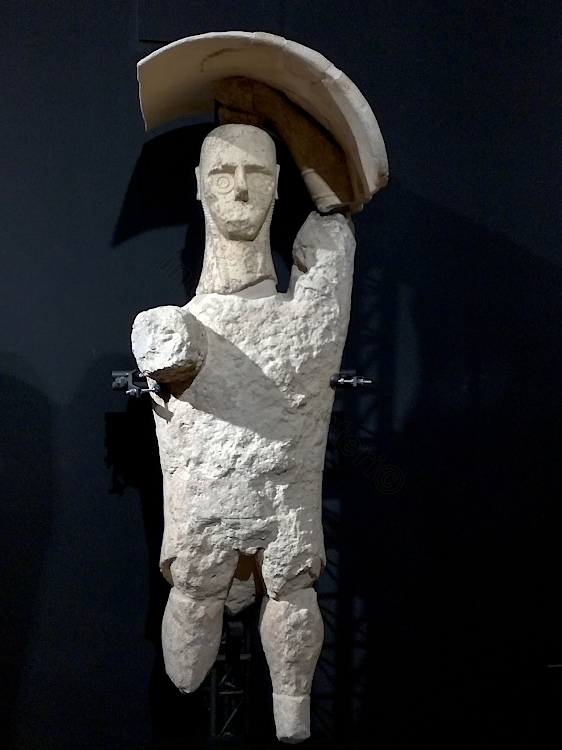
The sculptures depict imposing heroic figures, dating from the 9th to the 8th centuries BC. Their triangular faces appear highly stylised, with the nose and mouth carved in the distinctive T-shaped arrangement characteristic of Nuragic sculpture. Their striking eyes consist of two concentric circles, creating an intense, almost hypnotic gaze. Some figures wear long plaited hair falling down either side of the face. Their feet are shod in heavy sandals and stand upon substantial rectangular plinths. The artists kept decorative detail to a minimum, using mainly geometric and chevron motifs. They represented three principal figure types. Warriors wear horned or crested helmets and carry swords together with round shields. Boxers bear only the caestus on one hand and the distinctive curved shield above their heads. Archers carry bows and other weapons and are generally shown wearing a short tunic together with a breastplate (kardiophylax) and a protective forearm guard (brassard).
Statues, Bronzes and Nuragic Models
The sculptures of Mont’e Prama show striking parallels with corresponding types of Sardinian bronze figurines. In particular, they find clear counterparts in the so-called Abini-Teti style from central Sardinia9. The sculptures seem to translate this tradition into a refined stone medium, inspired by sculptural traditions originating in the Levant.
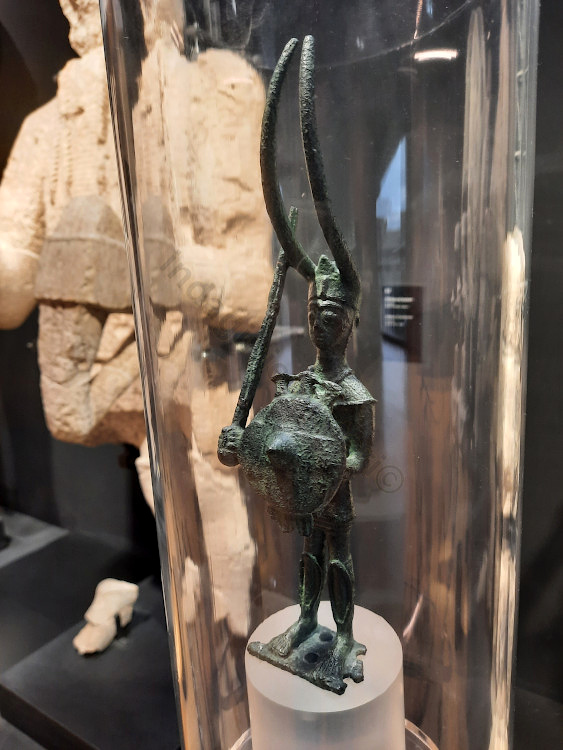
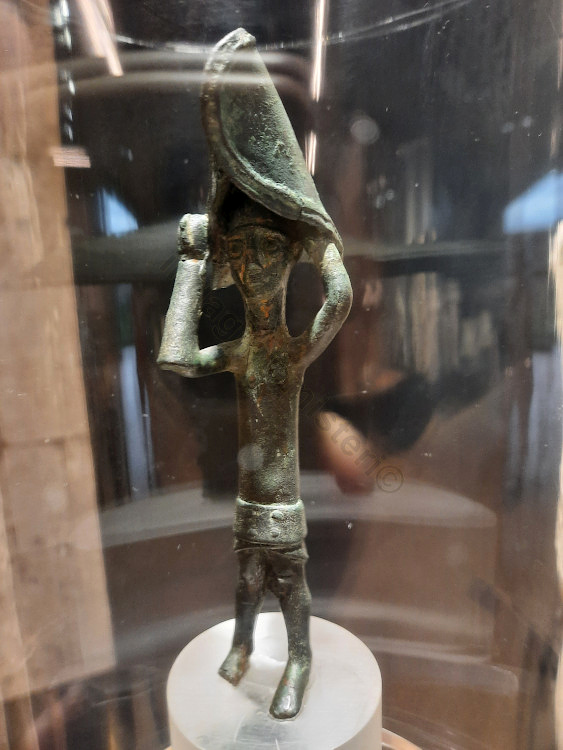
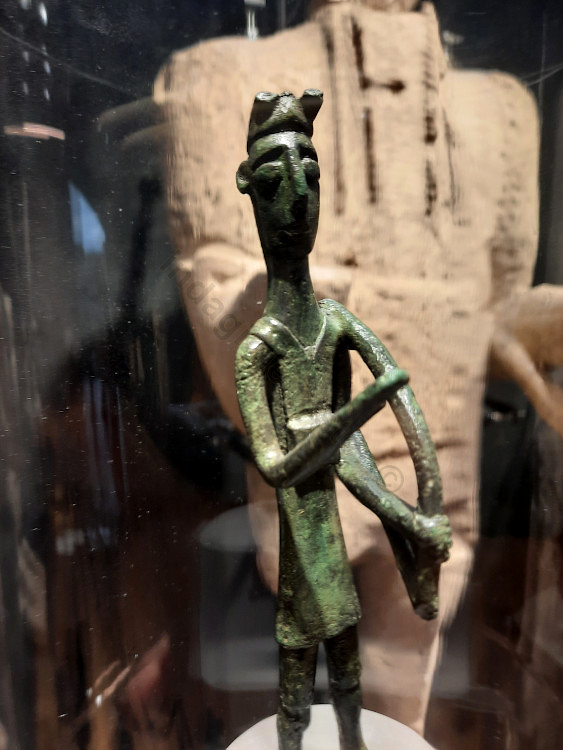
One variant of the boxer recalls a bronzetto from the Cavalupo necropolis at Vulci, dating to the 9th century BC. This Giant, shown in a gesture of devotion or prayer, carries a curved shield raised towards the viewer.
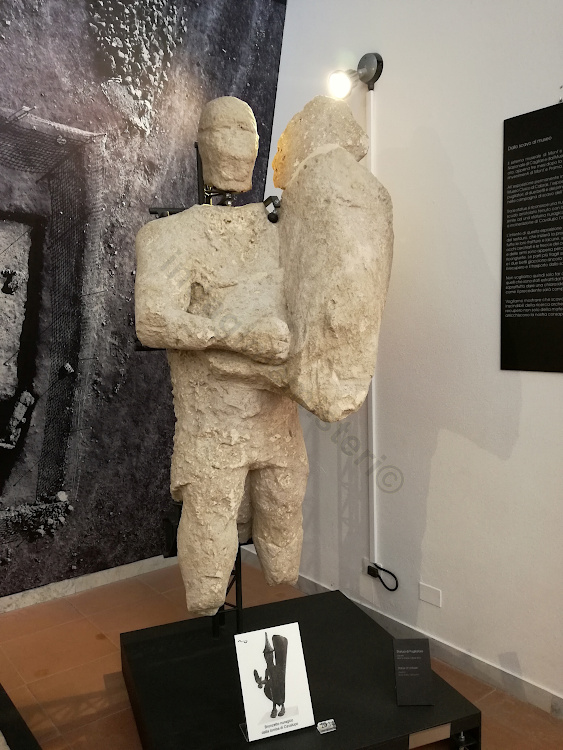
The necropolis of Mont’e Prama has also yielded numerous models of nuraghe, most of them carved in sandstone and only two in limestone. These sculptures depict single-tower, trilobed, quadrilobed and even pentagonal structures. They may have represented markers of political status or social hierarchy within the communities to which the deceased belonged.
The Age of the Giants of Mont’e Prama
The monumental burial complex at Mont’e Prama served as the burial place of the most prominent members of local Nuragic communities. The creation of imposing anthropomorphic sculptures, true kolossoi of Sardinia, undoubtedly reflected the will of the wealthy aristocracy that held power over these territories of the Sinis. The warrior and archer figures embody military authority. By contrast, religious or ritual power is embodied by the boxer figures in their orant-like stance. The nuraghe models, by contrast, serve as ancestral symbols of political sovereignty and territorial identity. Scholars still debate whether the Giants represented the deceased buried within the necropolis, portraying them as they appeared in life. Alternatively, they may have evoked heroic ancestors, transforming them into stone guardians who opened passages to the afterlife.
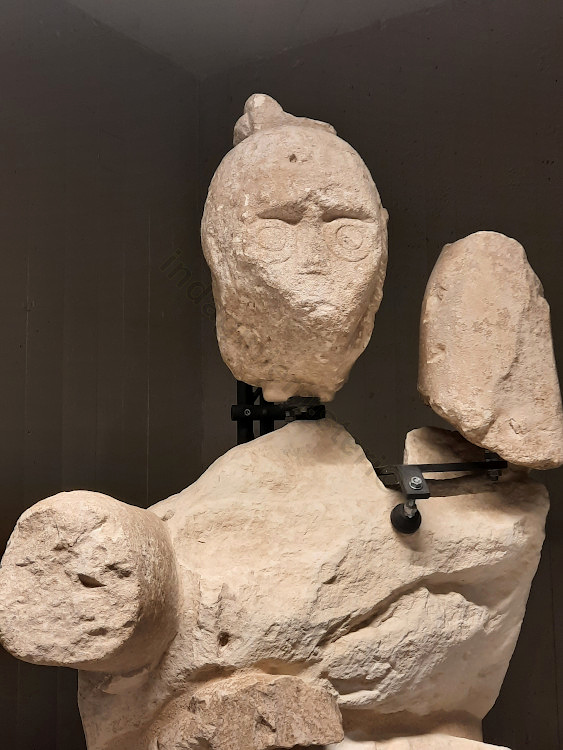
It is reasonable to assume that, at least for a period, the tombs and the statues formed part of a unified programme for the monumentalisation of this sacred area. The result was an extraordinary and highly ambitious artistic undertaking, remarkable not only for its aesthetic achievement but also for its social and symbolic implications, created by a civilisation that had reached a peak of cultural development at Mont’e Prama.
“From these artistic productions, the notion of a Nuragic Sardinia as a ‘lesser history’ compared with the ‘greater histories’ of other countries is entirely overturned. Here, Sardinia reaches the culmination of its ancient civilisation and achieves the finest expression of its social organisation, which stimulates art to manifest and illustrate it with vivid fidelity”.
Giovanni Lilliu, Bronzetti e statuaria nella Civiltà Nuragica, 1981. Translation by the author.
The Giants were not merely the result of renewed sculptural mastery; they also embodied the enduring values of Nuragic tradition. Like monumental territorial markers, they expressed collective identity and belonging to an age of heroes and ancestors, of warriors who continued to exist beyond the threshold of the known world. We can interpret the Mont’e Prama complex as an early form of heroon, a place devoted to ritual practice and collective memory for communities that had governed Sardinia for centuries.
Samuele Corrente Naso
Notes
- R. Zucca, Le statue colossali nuragiche di Mont’e Prama. Un giacimento funerario e cultuale. Nel volume: A. Moravetti, P. Melis, L. Foddai, E. Alba, La Sardegna Nuragica. Storia e monumenti, Corpora delle antichità della Sardegna, Carlo Delfino editore & C., 2017. ↩︎
- C. Tronchetti, P. Van Dommelen, Entangled objects and hybrid practices. Colonial contacts and elite connections at Monte Prama, Sardinia, in Journal of Mediterranean Archaeology, vol. 18, n. 2, 2005. ↩︎
- G. Lilliu, Dal betilo aniconico alla statuaria nuragica, StS, XXIV (1975-1977), Cagliari, 1977. ↩︎
- Archeologia, Franceschini: scoperta eccezionale, altri due Giganti emergono dalla necropoli di Mont’e Prama a Cabras. ↩︎
- The dating was obtained through radiocarbon analysis of the human remains. See note 1 above. ↩︎
- M. Rendeli, Mont’e Prama. Nel volume: A. Moravetti, P. Melis, L. Foddai, E. Alba, La Sardegna Nuragica. Storia e materiali, Corpora delle antichità della Sardegna, Carlo Delfino editore & C., 2014. ↩︎
- Ibidem note 1. ↩︎
- Giovanni Lilliu, La grande statuaria nella Sardegna nuragica, in Atti dell’Accademia nazionale dei Lincei. Memorie, IX, Accademia nazionale dei Lincei, Roma, 1997. ↩︎
- Ibidem. ↩︎