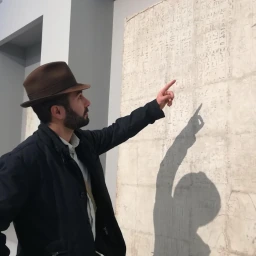
In the rugged countryside of Papasidero, within what is now the Pollino National Park, archaeologists uncovered a cave entrance in 1961 that had long been concealed beneath dense vegetation and forgotten for millennia. The site, later named Romito Cave, opened onto a narrow, dark passage carved primarily into limestone and concealed an extraordinary archaeological treasure. Excavations revealed a remarkable wealth of artefacts and numerous burials dating from between 23,000 and 10,000 years ago. Outside the cave, researchers also discovered a series of exceptional rock engravings, including the depiction of two aurochs (Bos primigenius).
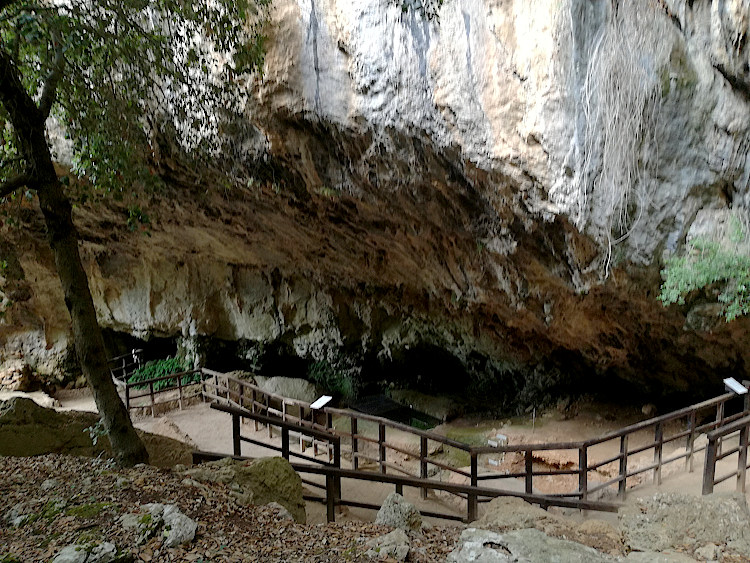
The first excavations, directed by Paolo Graziosi between 1961 and 1968 and later continued by the University of Florence, revealed that the Romito Cave had been occupied over an exceptionally long period1. Both inside the grotto and in the area immediately outside its entrance, archaeologists uncovered seven Upper Paleolithic burials containing the remains of nine individuals. These have been attributed to Cro-Magnon populations of Homo sapiens, among the earliest modern human communities to inhabit Europe. In the uppermost archaeological layers, researchers also identified a substantial deposit of obsidian. This evidence suggests that the site remained occupied during the Neolithic, when the volcanic glass was widely used to manufacture tools and weapons.
The ritual burials of the Romito Cave
The burials, placed in simple earthen graves, followed a well-defined funerary rite. The deceased were laid upon a bed of red ochre before being wrapped in animal hides, often decorated with thousands of marine shells and red deer teeth. Individuals also sometimes placed grave goods and ritual offerings, including arrowheads and bone bracelets, alongside the dead.
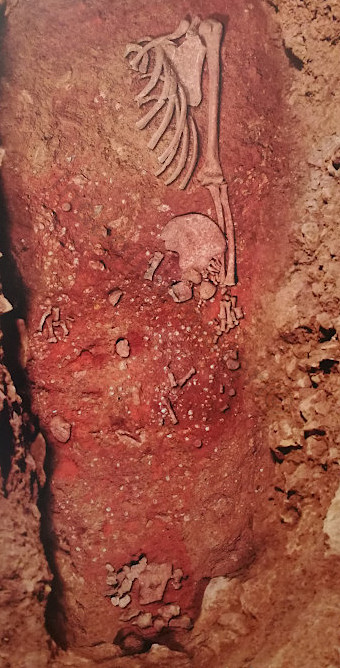
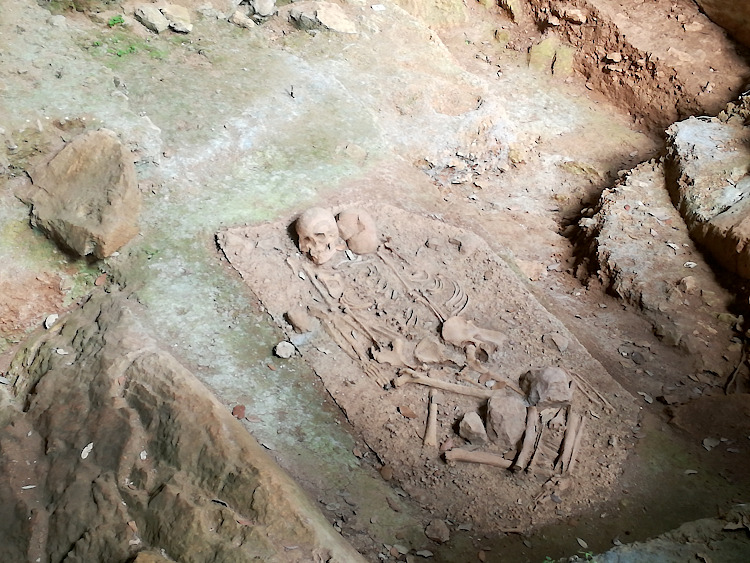
In at least one burial, dating to around 16,000 years ago, the skeleton was no longer anatomically articulated. This suggests the possibility of a secondary burial. Even more remarkable is the discovery of a double grave containing the remains of a man and a woman2. It remains uncertain, however, whether they were buried simultaneously or brought together at a later date. Along the inner edge of the rock shelter, archaeologists also uncovered a pit containing numerous animal bones, mainly those of deer, apparently deposited as part of ritual practices.
The engraving of Bos primigenius
On several smoothed rock surfaces outside the Romito Cave, archaeologists identified a series of remarkable rock engravings attributed to the final phase of the Epigravettian culture of the Upper Paleolithic, dating between 14,000 and 12,000 years ago. Among these, the most significant is the depiction of two bovids belonging to the extinct species Bos primigenius (the aurochs). Similar representations appear in European Paleolithic parietal art, such as the famous paintings of Lascaux in France. In the Papasidero example, one figure is clearly visible, while the second, positioned near the hind legs of the first animal, appears only lightly sketched. It is likely that the engravings were originally enhanced with pigments that have not survived.
The aurochs was one of the largest herbivores of Ice Age Europe, standing over 1.8 metres at the shoulder and representing both a prized and dangerous quarry. The anatomical accuracy of the engraving suggests that the artist was intimately familiar with the animal and intended to emphasize its strength and imposing presence.
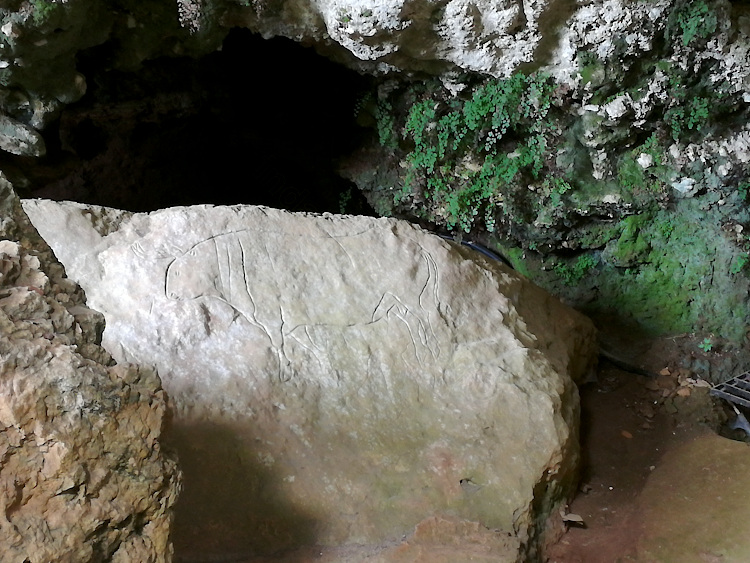
The presence of aurochs imagery at Papasidero, as at Lascaux, is not surprising. Upper Paleolithic Homo sapiens communities did not practice agriculture or animal husbandry. Hunting Bos primigenius was a crucial source of subsistence. As a result, the animal acquired strong symbolic and sacred significance, associated with life, the natural world, and fertility. Depicting the aurochs may also have served a symbolic function of control over the animal, intended to ensure successful hunts.
Non-figurative engravings
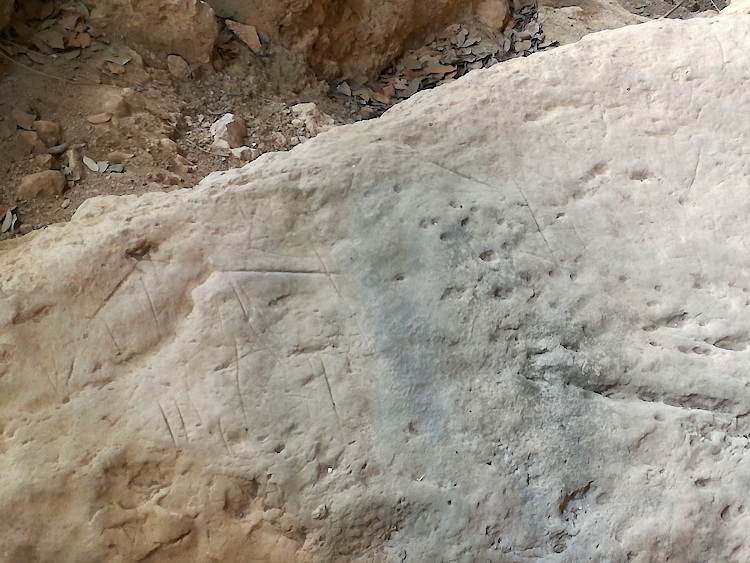
Not far from the aurochs depiction lies a slab-like rock whose surface shows a series of fine incisions. These do not appear to form any recognisable figurative pattern. Archaeologists have proposed several interpretations of this unusual feature. One hypothesis suggests that the surface may once have been painted, and that the incisions are the only surviving traces of a painted scene that originally depicted a recognisable subject around 10,000 years ago. Another possibility is that the markings represent an early counting system or symbolic notation. However, the most plausible interpretation is that the rock functioned as a sacrificial or ritual altar. Thus, the incisions could be the result of repeated use of stone tools. This interpretation is consistent with the nearby presence of a large pit containing animal remains.
The interior of the Romito Cave
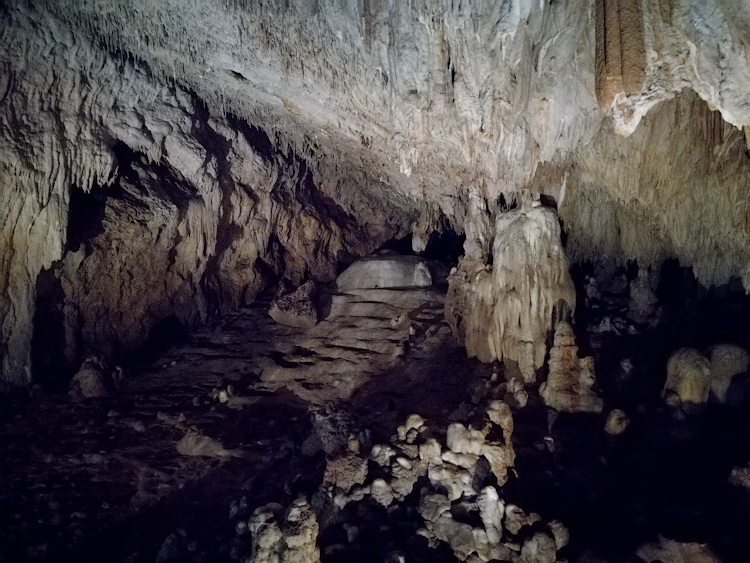
The Romito Cave is approximately 20 metres deep and 34 metres long. A narrow corridor leads into a large chamber of striking natural beauty. Inside the cave, the temperature is approximately 13-15°C throughout both winter and summer. This microclimatic stability has favoured the formation of impressive limestone deposits, including stalactites and stalagmites.
Was the Romito Cave a sacred place?
Upper Paleolithic communities must have been deeply impressed by the natural setting of the Romito Cave. Hence, they may have regarded it as a prehistoric “sanctuary”. At Papasidero, different forms of ritual practice appear to coexist and are, in fact, interconnected. The presence of burials, ceremonial activities, and the propitiatory depiction of Bos primigenius, a sacralised animal essential to the group’s survival, all seem to belong to the same symbolic worldview: what came from the earth returned to it. The Romito Cave thus represents a site of exceptional cultural and spiritual significance, reflecting the profound bond between Epigravettian communities and the natural world surrounding them.
Samuele Corrente Naso
Notes
- https://www.museofiorentinopreistoria.it/it/ricerche-e-scavi/scavi-in-corso. Article to this link. ↩︎
- https://www.grottaromito.com/it ↩︎