The concept of the Sacred Centre is as old as humanity. Since the earliest forms of symbolic knowledge, it has represented the place of divine encounter, the space where the transcendent manifests itself. Its geometry has a centre, which is the image of the principle from which all things were brought into being. Furthermore, it is sacred as a reflection of the Supreme Being, the otherworldly deity. Every civilisation has had its own conception of sacer. It is a Latin term expressing “that which belongs to something else”, which thus introduces a supersensible, numinous order.
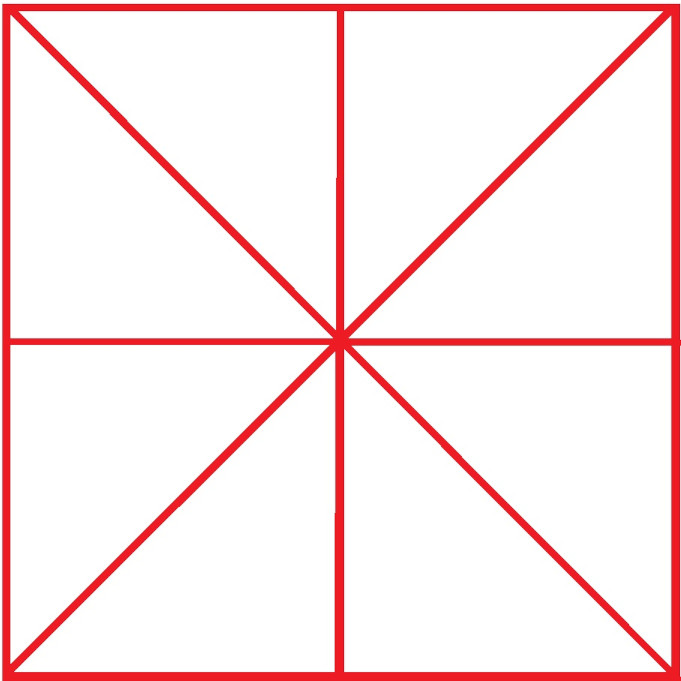
The eminent historian of religions, Mircea Eliade, traced the symbolism of the Sacred Centre back to three distinct sets of meanings, linked to the concepts of a place of encounter with the divine, a space of creation, and the axis mundi1.
The mountain as a Sacred Centre
According to Eliade, it is on the sacred mountain that humans finds the ideal place for an encounter with the supernatural. On the mountain, in fact, heaven and earth ideally meet, the dimension of matter merges with the metaphysical one. A characteristic example is the sacred significance of mountains for Jews. Yahweh gives Moses the Tablets of the Law on Mount Sinai. Furthermore, “Tabor and Hermon rejoice in your name”2.
“The symbolic and religious significance of mountains is endless. Mountains are often looked on as the place where sky and earth meet, a ‘central point’ therefore, the point through which the Axis Mundi goes, a region impregnated with the sacred, a spot where one can pass from one cosmic zone to another.
The mountain, the temple, the city, and so on are consecrated because they are given the attributes of the ‘centre’; originally, that is, they were assimilated into the highest point of the universe, and the point where heaven and earth meet”.
Mircea Eliade, Patterns in Comparative Religion, Translated by Rosemary Sheed, 1996.
Temples and cultic buildings
Eliade also sees in the construction of temples and palaces by ancient civilisations a need to mediate with the divine. To this extent, they mimicked the sacred function of the mountain and, in many cases, tended to take its form. For the Jews the Sacred Centre became the Temple of Solomon in Jerusalem. Here they solemnly placed the Ark of the Covenant, with the Tablets of the Law, inside the Sancta Sanctorum3.
The ancient Babylonians placed on the top of the ziggurats a temple of encounter with the divine. Such “zaqaru“, high places, allowed special rites to be performed in which the cosmic union between man and heaven was renewed4.
This same symbolism of the center explains other series of cosmological images and religious beliefs. […] temples are replicas of the cosmic mountain and hence constitute the pre-eminent “link” between earth and heaven […].
The ziggurat was literally a cosmic mountain; the seven stories represented the seven planetary heavens; by ascending them, the priest reached the summit of the universe. An entire country (e.g., Palestine), a city (Jerusalem), a sanctuary (the Temple in Jerusalem), all equally well present an imago mundi […]
It is clear, then, that both the imago mundi and the Center are repeated in the inhabited world. Since the sacred mountain is an axis mundi connecting earth with heaven, […] it is symbolically situated at the Center of the World. The multiplicity, or even the infinity, of centers of the world raises no difficulty for religious thought.
Mircea Eliade, The Sacred and the Profane, Translated from the French by Willard R. Trask, 1959.

The Axis of the World concept
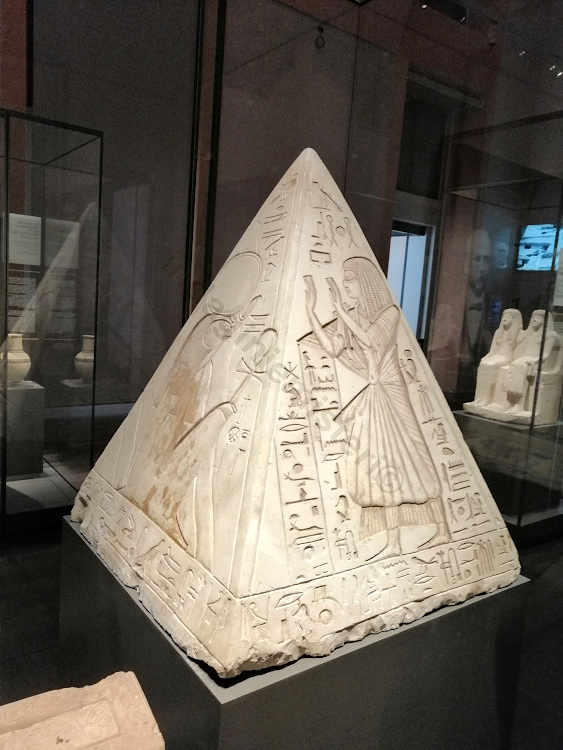
Temples, palaces and mountains are all expressions of an axis mundi, the axis of the world where the connection between the earthly and the celestial realms, between the world of the living and the transcendent, is established. For the ancient Egyptians of Heliopolis, matter, life and light originated from a single cosmic axis, a primordial hill that emerged from the waters of Nun, called Benben. For this reason, at the solar temple of Heliopolis, there was a stone that embodied the very substance of the divine and evoked the form of Benben. This gave rise to the symbolic-religious tradition of the obelisk and the pyramidion. Similarly, this helps explain the symbolism of the Djed. Indeed, this was a sacred hieroglyph depicting the spine of Osiris and, as such, rising to become the very axis and pillar of the Universe.
The Omphalos and the Sacred Centre for the Greeks
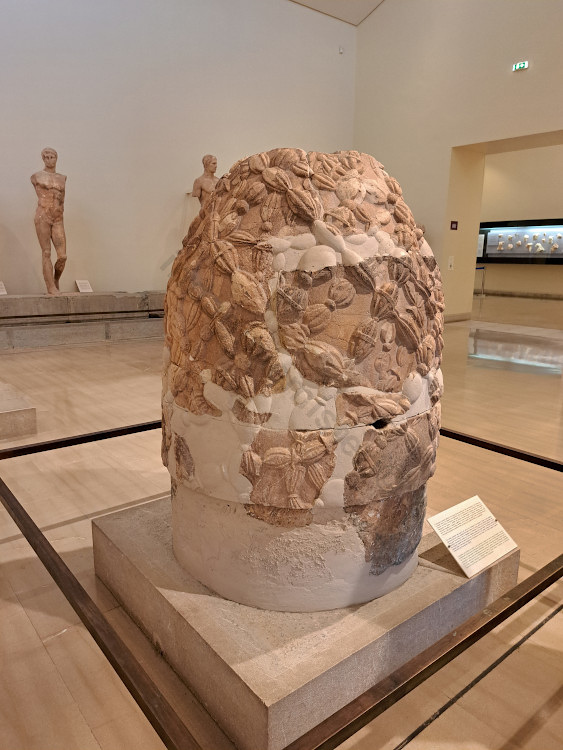
The ancient Greeks also expressed the concept of the Sacred Centre through a cultic stone. This was called Omphalos and connected with the concept of the Axis of the World. The Omphalos, which literally means “navel”, was placed in the Temple of Apollo at Delphi, as it was believed that the centre of the Universe was located there5. The rock was finely carved and covered with net-like bands, signifying all creation that originated from the divine. At the Omphalos the Oracle of Delphi revealed her prophecies, and therefore it represented the privileged encounter point with divinity. For this reason, the term has by extension become synonymous with the Sacred Centre.
The Cross and Christianity
With the advent of Christianity, the point of encounter between humanity and the divine became Christ himself. He is the one who possesses both an earthly and a heavenly nature. The cross of Christ stands on a sacred mountain, Calvary, and represents the axis mundi. The horizontal beam symbolises the earthly dimension of creation. The vertical beam represents the relationship with God. Through his death and resurrection, Christ embodies the axis of the world, the sacred mountain and, ultimately, the temple. Indeed, he states in the Gospels: “Destroy this temple and in three days I will raise it up”6. An interesting figurative representation of the Sacred Centre can therefore be derived from the intersection of the Chi-Rho monogram, an abbreviation of the name Christós itself, and the cross.

The Sacred Centre in the Middle Ages
During the Middle Ages, the symbol of the Sacred Centre spread widely throughout Europe by graffiti, engravings, wall paintings, even in more elaborate forms.

Some of these depictions, such as those at Chinon, are found in places associated with the Knights Templar, who undoubtedly contributed to the symbol’s spread. The Templars were the ideal guardians of the Sacred Centre, given their presence in Jerusalem, in the area of the ancient Temple of Solomon.
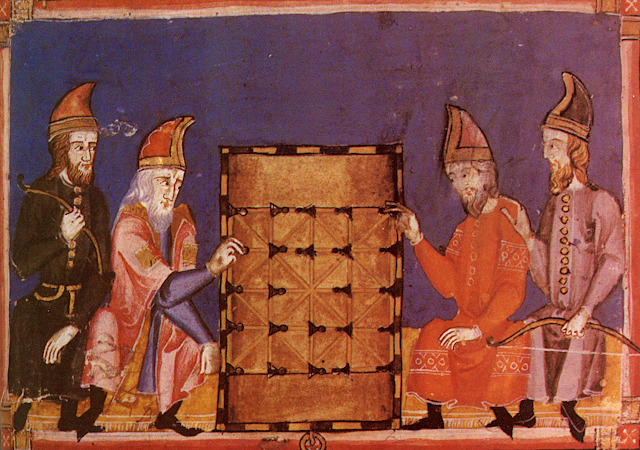
Ultimately, throughout history, the symbol of the Sacred Centre has come to embody the very attributes of God. It thus represents the Absolute, the principle that generates and orders all things, which would otherwise fall into chaos. As a centre, it is the singularity from which matter was generated and to which all must return.
Samuele Corrente Naso
Notes
- Mircea Eliade, Patterns in Comparative Religion, University of Nebraska Press, 1996. ↩︎
- Psalm 89, 13. ↩︎
- Book of Kings 1, Chapter 8. ↩︎
- Mircea Eliade, The Sacred and the Profane, Translated from the French by Willard R. Trask, Brace and Company, Harcourt, 1959. ↩︎
- W. H. Roscher, Omphalos, in Abhandl. sächs. Ges. Wiss., XXIX, 1913. ↩︎
- John 2,19. ↩︎