From its very origins in myth, the siren has been a fascinating yet dangerous creature, whose melodious song could enchant men and lead them to ruin. Whoever listened to her voice would lose both will and reason, surrendering to the ecstasy of the senses, with no possibility of return. This monstrous being embodied the image of deadly temptation, hidden behind beauty and the desire for listening and knowledge. These symbolic attributes accompanied the siren throughout history, despite changes in cultural contexts and even in iconography. Indeed, the winged figure of antiquity evolved into the double-tailed mermaid form widely represented in Romanesque churches of medieval Europe.
Sirens in Myth
The first mention of the Seirḗnes (Σειρῆνες) appears in the Odyssey by Homer (8th–9th century BC), when the sorceress Circe advises Odysseus on how to resist their hypnotic song1. These creatures, who dwelt on rocky islands near Scylla and Charybdis, lured unsuspecting sailors to their doom by causing them to crash upon the rocks. The sound of their voices was so melodious and persuasive that it could tempt even the most virtuous of heroes. Odysseus, fully aware of the danger, had himself bound to the mast of his ship in order to survive.
“First off, you’ll come to the Sirens. They bewitch
Homer, Odyssey, Book XII, lines 39–54. Translation by P. Green, University of California Press, 2018.
and beguile all mortals who come within earshot of them.
Any man who unwittingly gets close enough to hear
the Sirens’ voices will never again be surrounded
by wife and children greeting him on his return home;
the Sirens will enchant him with their clear high singing
as they sit in a meadow, among great heaps of bones
from men’s rotted bodies, the skin on them all shriveled”.
Homer also reveals the nature of the sirens’ irresistible temptation. They themselves declare it:
“Look in here on your way, famed Odysseus, the Achaians’ pride: put in with your ship, hear the song we two sing! Never yet
Homer, Odyssey, Book XII, lines 184-188. Translation by P. Green, University of California Press, 2018.
has any man rowed on past us in his black ship till he’s heard
the honey-sweet music that issues from our mouths,
and he voyages on rejoicing, his knowledge increased”.
The sirens attempt to seduce Odysseus through flattery and the promise of pleasure and knowledge, desires that lead men into irrationality and a loss of contact with reality. In the Odyssey there is no description of the appearance of these malevolent beings. Their image must already have been deeply rooted in the collective imagination. It is artistic representations that reveal the form of a siren: a terrifying creature, half maiden and half bird.

The Siren between Earth and the Underworld
According to myth, the sirens were daughters of the river god Achelous2. He had fallen in love with a maiden named Deianira, whom, however, Heracles also sought in marriage. The two rivals engaged in a fierce struggle and Achelous, who had assumed the form of a bull, was defeated. From one of his broken horns flowed blood which, falling upon the Earth goddess, gave birth to the sirens. These beings were not born as monstrous creatures. Indeed, Demeter transformed them into bird-women because they had failed to protect her daughter Persephone when Hades dragged her into the Underworld to claim her as his bride3. In other myths, however, the sirens are daughters of the Muse Terpsichore, who bestowed upon them the gift of song4.
The sirens therefore oscillate between the realm of the earth, of which they are daughters, and that of the Underworld. In Helen by Euripides (412 BC), they are invoked to intone a funeral lament from Hades, where they dwell, in memory of those who fell in the Trojan War5. In the Argonautica by Apollonius Rhodius (3rd century BC), the crew of the ship Argo, on their journey home after recovering the Golden Fleece, encounter the sirens and their seductive song. Fortunately, Orpheus, taking up a lyre, succeeds in overpowering the fatal melody and saving his companions6.
“And a fresh breeze wafted the ship on. And soon they saw a fair island, Anthemoessa, where the clear-voiced Sirens, daughters of Achelous, used to beguile with their sweet songs whoever cast anchor there, and then destroy him. Them lovely Terpsichore, one of the Muses, bare, united with Achelous; and once they tended Demeter’s noble daughter still unwed, and sang to her in chorus; and at that time they were fashioned in part like birds and in part like maidens to behold”.
Apollonius Rhodius, Argonautica, Book IV, 891-899. Translation by R. C. Seaton, William Heinemann Ltd, London, 1912.

The image of perdition
For Ovid, before being transformed into birds, the sirens were beautiful and seductive maidens7. This interpretation of the myth, found in the Metamorphoses (2–8 AD), influenced later literature well into the Middle Ages. In the Naturalis Historia (77–78 AD), Pliny the Elder described them as “fabulous birds”. They lull their victims to sleep with their song before tearing them apart8.
The figure of the siren also survived the spread of Christianity. In the Greek translation of the Bible, known as the Septuagint, the term σειρήνα was used to refer to the desert jackals called tannîm by the Hebrews, perhaps because of the mournful cry of these animals. Saint Jerome, author of the first Latin translation of the sacred text, the Vulgate (c. 347–420 AD), attempted to explain this curious association in his Commentary on Isaiah:
“Sirenae autem thannim vocantur, quas nos aut daemones aut monstra quaedam, vel certe dracones magnos interpretabimur, qui cristati sunt et volantes”.
“The sirens, however, are called tannîm, which we would interpret either as demons, or as certain monsters, or indeed as great dragons, which are crested and winged”.
Jerome, Commentaria in Isaiam Prophetam, VI, 14 and V, 13:20-22, in Patrologia Latina, vol. 24, cols. 216B and 159C.
For Jerome, therefore, the sirens are a kind of flying dragon. These great serpentine monsters, above all, are demons that devour human beings. The saint associates these demons with heretics9. Following the mythological tradition, Isidore of Seville likewise described them as beings of perdition:
“People imagine three Sirens who were part maidens, part birds, having wings and talons; one of them would make music with her voice, the second with a flute, and the third with a lyre. They would draw sailors, enticed by the song, into shipwreck. In truth, however, they were harlots, who, because they would seduce passers-by into destitution, were imagined as bringing shipwreck upon them. They were said to have had wings and talons because sexual desire both flies and wounds. They are said to have lived among the waves because the waves gave birth to Venus”.
Isidore of Seville, Etymologiae, XI, III, 30-32. Translation by S. A. Barney, W. J. Lewis, J. A. Beach, O. Berghof, Cambridge University Press, 2006.
From the Physiologus to the Bestiaries
Alongside the writings of the Church Fathers, in the early centuries a literary tradition developed that combined naturalistic descriptions of living beings, both real and imaginary, with allegorical and moral interpretation. The earthly world, as God’s creation, was understood as a reflection of a higher, spiritual reality. Nature was read symbolically, and everything was seen as an image of virtues and vices, of holiness and sin. This literary genre, often accompanied by miniature illustrations, traces its origins to Book XII of Isidore of Seville’s Etymologiae and especially to the Greek Physiologus, a work of the 2nd–3rd century AD by an anonymous Alexandrian author10, and it reached its fullest development in the medieval bestiaries. In the Greek Physiologus, the sirens, like the ass-centaurs, a monster half man and half ass, serve as an allegory of human duplicity.
“Formerly, Isaiah the Prophet pointed out that the sirens and ass-centaurs and hedgehogs will come into Babylon and dance. Physiologus treated the nature of each one, saying of the sirens that they are deadly animals living in the sea which cry out with odd voices, for the half of them down to the navel bears the figure of a man, while the other half is that of a bird. Likewise, the ass-centaurs from their breasts up bear the figure of a man and that of an ass from there down. Thus the man of deceitful heart is confused in all his ways. Such are the impulses of the souls of wicked merchants; they even sin secretly while gathered
Physiologus, translation by M. J. Curley, The University of Chicago Press, London, 2009.
together in church. As the Apostle said, ‘Holding the form of piety, they deny its virtue’. And in church their souls are like sheep, yet when they are released from the congregation they become like the herd. They are like brutish beasts”.

In a later version, the Latin Physiologus (versio B), a translation probably dating from the 4th–5th century, the sirens are instead compared to men who abandon themselves to the pleasures of the flesh and to worldly entertainment11.
The metamorphosis of the siren
Up to this point, sirens are almost always described and depicted in their customary bird-like form. From a certain point onward, however, in medieval art they undergo a curious metamorphosis and take on fish-like features. In this guise, they appear most widely represented, particularly in the Romanesque sculpture of central and northern Italy.

Scholars have proposed several explanations for this sudden transformation: the error of a monastic scribe who, instead of writing pennae (“feathers”), wrote pinnae (“fins”)12; a certain confusion with the sea monster Scylla, or with the biblical story of the prophet Jonah, swallowed by a great fish13. In myth their father was the river deity Achelous, often depicted as a triton, and this certainly played a role14.

In any case, the earliest description of sirens in this transformed form is in a 7th–8th-century bestiary, the Liber monstrorum de diversis generibus15:
“Sirens are sea-girls, who deceive sailors with the outstanding beauty of their appearance and the sweetness of their song, and are most like human beings from the head to the navel, with the body of a maiden, but have scaly fishes’ tails, with which they always lurk in the sea”.
Liber Monstrorum, translation by A. Orchard, Pride and Prodigies. Studies in the Monsters of the Beowulf-Manuscript, University of Toronto Press, 1995.
The two-tailed siren in medieval Christian art
Perhaps for reasons of greater stylistic and expressive effect, medieval sculptors soon adopted the form of the two-tailed siren. Frequently depicted in friezes, decorative panels, capitals, or floor mosaics, it served as a warning against the dangers of lust.

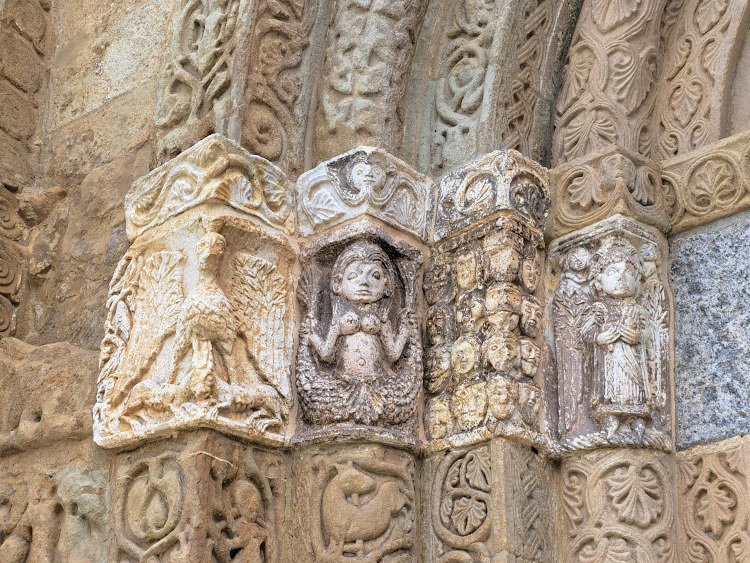
With this meaning, it is already found represented in sculptural form in the early Romanesque pulpit of the Parish Church in Gropina, near a man being devoured by diabolical serpents. Another two-tailed siren stands on the portal’s lintel of the Parish Church of Corsignano in Pienza. By contrast, a chaste female figure acts as a caryatid in the double-arched window on the façade. An alluring siren is on the jamb of the left portal of the Basilica of San Michele in Pavia. Here, a variety of beasts and dragons are destined to be defeated by the Archangel, commander of the heavenly host16. In the Sacra di San Michele in the Susa Valley, the creature, carved by the Master of Rivalta17, is part of the decoration accompanying Nicholaus’ Zodiac Portal. The siren also appears on a capital in the crypt of Modena cathedral, executed by the Comacine masters.
We can admire fine mosaic representations, instead, in the crypt of the Abbey of San Colombano in Bobbio and in the Church of San Giovanni Decollato in Pieve Terzagni. In the sea of temptation, the medieval two-tailed siren reminded the faithful and pilgrims of the importance of not straying from the Christian path.
Notes
- Homer, Odyssey, Book XII, lines 39–54. ↩︎
- Ovid, Metamorphoses, Book IX, line 1. ↩︎
- Hyginus, Fabulae, 141. ↩︎
- Apollonius Rhodius, Argonautica, Book IV, lines 895-896. ↩︎
- Euripides, Helen, lines 167–179. ↩︎
- Apollonius Rhodius, Argonautica, Book IV, lines 890–912. ↩︎
- Ovid, Metamorphoses, Book IX, lines 551-555. ↩︎
- Pliny the Elder, Naturalis Historia, X, 70. ↩︎
- N. Pace, Il canto delle sirene in Ambrogio, Gerolamo e altri Padri della Chiesa, in Nec timeo mori, Atti del Congresso internazionale di studi ambrosiani nel XVI centenario della morte di sant’Ambrogio (Milano, 4-11 aprile 1997), a cura di L. F. Pizzolato e M. Rizzi, Vita e Pensiero, Studia patristica Mediolanensia, 21, Milano, 1998. ↩︎
- A. Scott, The date of the Physiologus, in Vigiliae Christianae, 52, 1998. ↩︎
- Physiologus latinus Versio B, testo a cura di Francis J. Carmody; nota intr. e note di Francesco Zambon; traduzione a cura di Claudia Cremonini, in Bestiari tardoantichi e medievali. I testi fondamentali della zoologia sacra cristiana, Giunti Editore-Bompiani, Firenze-Milano, 2018. ↩︎
- L. Bonoldi, Le sirene dall’antichità ad oggi. Né carne né pesce, in Art e dossier, a. XXV, vol. 262, 2010. ↩︎
- L. Pasquini Vecchi, Arpie, Sirene e Melusine nei pavimenti musivi dell’Italia medievale, in Atti dell’VIII Colloquio dell’Associazione Italiana per lo Studio e la Conservazione del Mosaico (Firenze, 21-23 febbraio 2001), a cura di F. Guidobaldi, A. Paribeni, Ravenna, Edizioni del Girasole, 2001. ↩︎
- W. Wunderlich, Suoni ammalianti, irresistibile attrazione. Storia delle sirene dall’antichità al Barocco, in Sangue di drago. Squame di serpente. Animali fantastici al Castello del Buonconsiglio (catalogo della mostra, 10 agosto 2013-6 gennaio 2014), a cura di F. Marzatico, L. Tori, con A. Steinbrecher, Skira, Ginevra-Milano, 2013. ↩︎
- S. Moretti, R. Boccali, S. Zangrandi, La sirena in figura, forme del mito tra arte, filosofia e letteratura, Pàtron Editore, Bologna, 2017. ↩︎
- J. Leclercq-Marx, Da Pavie à Zagósc: la sirène comme motif de prédilection des sculpteurs “lombards” au XIIe siècle, in Arte lombarda, n.s., a. CXL, vol. 1, 2004. ↩︎
- C. Tosco, Nuove ricerche sul portale dello Zodiaco alla Sacra di San Michele, in La trama nascosta della cattedrale di Piacenza, a cura di T. Fermi, Tip.Le.Co., Piacenza, 2015. ↩︎