The imposing Basilica of San Michele Maggiore dominates the centre of Pavia. It is the Romanesque soul of the city, still alive and present today. With its massive appearance, the sandstone walls adorned with friezes and symbols tell of the history, faith, and culture of the Middle Ages. Like an illustrated compendium, they reveal a distant and fascinating world. The building was an important stop on the Via Francigena, the main road from France to Rome. In the Pavia basilica, pilgrims could find both physical and spiritual respite. They could entrust themselves to the protection of Saint Michael, commander of the heavenly militia1 who defeats the dragon-serpent and protects pilgrims from evil throughout their journey.
Moreover, the church stood on the site of the ancient royal buildings of the Lombards, a people devoted to the Archangel, when Pavia was the capital of the Regnum Langobardorum. The city was the most important military centre of the Kingdom and, starting with Adaloald in 603, also the permanent residence of the kings. The royal Palatium of Pavia was the administrative and cultural hub of the entire Langobardia Maior2.

The Basilica of San Michele Maggiore in Pavia
The city’s principal religious building was dedicated to Michael the Archangel, located next to the Palatium, of which no trace remains today. Historical sources indicate that during the Carolingian period, the palatine chapel hosted the coronation of several kings of Italy. It is certain that Berengar II and his son Adalbert (950)3, Arduin of Ivrea (1002), and Henry the Saint (1004) were enthroned there. An unconfirmed tradition lists others, including Berengar I (888)4. Paolo Diacono, the great historian of the Lombards, attests to the existence of the first basilica as early as 6625, revealing that the cult of Saint Michael was introduced to Pavia by the Duke of Benevento, Grimoald, to celebrate the victory against the Byzantines at Siponto in 650, the outcome of which had been entrusted to the Archangel of the famous sanctuary on Mount Gargano6.
The Lombard basilica was not yet the one we see today. The church was rebuilt after the devastating earthquake of 1117 and its construction was entrusted to the Comacine Masters. It was therefore used by Frederick Barbarossa as a magnificent setting for his coronation: the sovereign was blessed and proclaimed King of Italy in the spring of 1155, “in ecclesia sancti Michaelis, ubi antiquum regum Longobardorum palatium fuit”7. In Pavia he received renowned the Iron Crown, an ancient symbol of Lombard power8.
“Roma nominat Papiam et appellat filiam suam. Et sicut Roma coronat imperatorem in ecclesia Sancti Petri cum papa suo, ita Papia cum episcopo suo coronat regem in ecclesia Sancti Michaelis Maioris, ubi est lapis unus rotundus cum quatuor aliis lapidibus rotundis”.
“Rome names Pavia and calls her her daughter. As Rome, with her pope, crowns the emperor in the church of Saint Peter, so Pavia, with her bishop, crowns the king in the church of San Michele Maggiore, where there is a single round stone surrounded by four other round stones”.
Honorantie civitatis Papie, rr 8-11, circa 1020.
Much of the sculpture and symbolism at San Michele Maggiore in Pavia is related to royalty.
A Romanesque basilica
In keeping with the well-established architectural traditions of the Lombardy region, the Magistri Cumacini built the Basilica of San Michele Maggiore in Pavia in an impressive and mature Romanesque style. The Latin cross plan features three short naves and a semicircular apse. An octagonal lantern tower rises above the crossing, while barrel vaults span the transept arms. The four ribbed vaults of the central nave, on the other hand, were rebuilt between 1488 and 1491 to replace the older ones, which appeared to be unsafe. Powerful clustered pillars mark the bays and support the narrow matronea, illuminated by a series of sober mullioned windows.
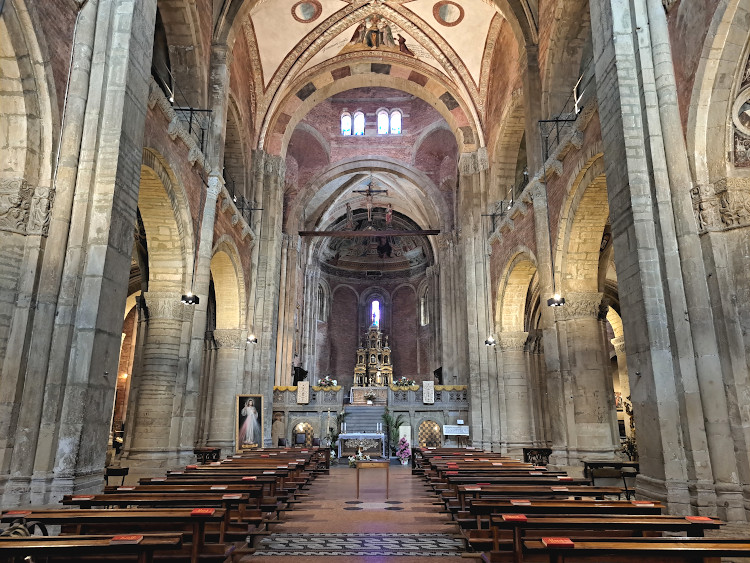
The capitals along the aisles feature carvings depicting sacred scenes, such as the Death of the righteous and the Sacrifice of Cain and Abel. These scenes focus on the themes of sin and redemption. The presbytery’s raised position is due to the crypt located beneath it. A valuable 12th-century fresco of a Dormitio Virginis is located in a central chapel on the southern arm of the transept9.


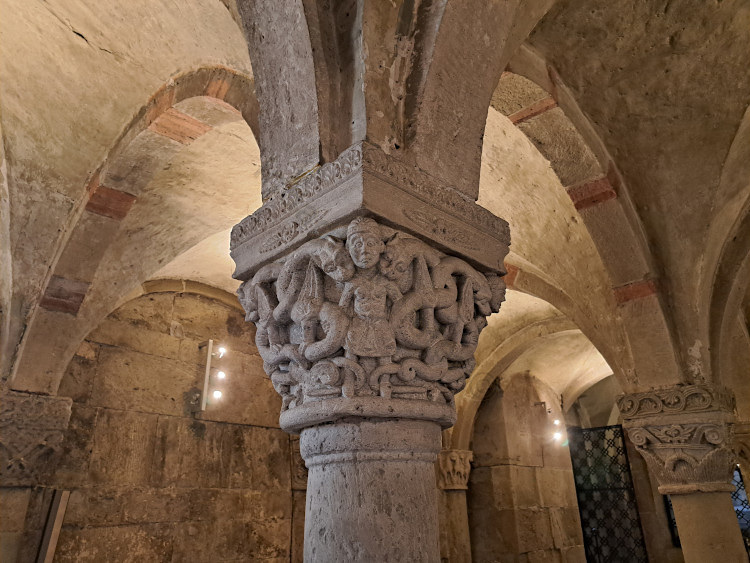
The crypt beneath the presbytery is visually striking. The three-nave space with cross vaults features exquisite carved capitals. Some of them, adorned with plant motifs, may date back to the pre-existing Lombard church. Among the Romanesque decorations, recognisable by the greater modelling of the bas-reliefs, are several winged dragons, intertwined with each other.

The sculptures and symbols on the façade of San Michele Maggiore in Pavia
The tripartite gabled façade has thick buttresses that, in addition to performing a structural function, frame the three portals and simple openings consisting of mullioned windows, single-light windows, oculi and a cross. There are nine elements in total, a number representing divinity in Christian symbolism. A small loggia featuring columns and round arches tops the façade.
The sculptural decorations of the façade are particularly noteworthy. Despite the deterioration of the sandstone, they still convey a strong expressive and symbolic power. To understand their meaning, we must first consider who they were intended for: not only pilgrims on the Via Francigena, but also ordinary citizens of Pavia who saw the power of Emperor Frederick Barbarossa manifested in the façade of the Basilica of San Michele. The sculptural programme therefore served a dual purpose. It was an exposition of vices and virtues, educational and inspirational for the faithful on their journey, and furthermore it celebrated royalty in all its aspects. However, it seems that the iconography of San Michele conveyed a more complex message, impossible to decipher today.

The figure of the Archangel Michael
Interestingly, Saint Michael is the protagonist of a devotion that brings together contrasting terms. He is the protector of both the pilgrim and the king, of life as well as of death. As the commander of the heavenly militia and the Princeps par excellence, the Archangel defeats the evil dragon-serpent and is therefore the undisputed patron of every sovereign. Nevertheless, he is also an intermediary for the faithful between the divine and earthly spheres. They invoked Saint Michael to obtain spiritual blessings and healing from bodily afflictions. He is also a psychopomp, accompanying souls to heaven after death.
The place of honour at the centre of the façade of the Basilica of Pavia, just above the main portal, is reserved for a bas-relief of the Archangel. Saint Michael watches over the Basilica, marking the boundary between the outside world and the sacred space of God’s house. He prevents evil, in all its forms, from entering.

Decorative themes and motifs
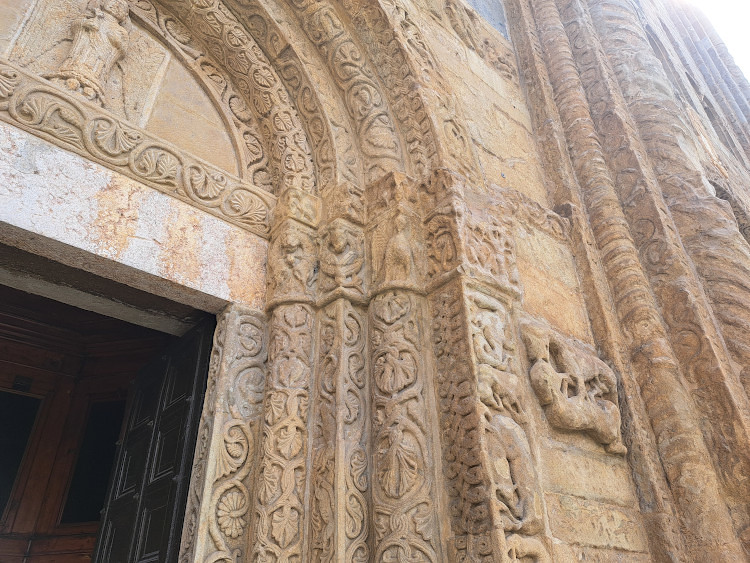
Along the entire façade, friezes and sculptures arranged in horizontal bands adorn the figure of Michael. The portals are also richly decorated, particularly at the level of the splayed jambs, archivolts and capital bands. These are the best-preserved sculptures as they are made of limestone, which is more resistant. Unfortunately, due to weathering, it is no longer possible to fully reconstruct the iconography of the façade. With some difficulty, we can recognize an Agnus Dei next to the main portal, a depiction of Original Sin of Adam and Eve, and indistinct scenes of fishing, hunting, and combat. Vines, spirals and plant motifs represent an early medieval stylistic tradition, here with an unusually naturalistic treatment. At the level of the portal splay, Solomon’s knots and various spiral motifs are clearly visible.
The bestiary of the Basilica of San Michele Maggiore in Pavia
Then there are images of travellers, musicians, blacksmiths and knights being overwhelmed by monsters and abominations of all kinds, as well as pious silhouettes of bishops. It is in these sculptures that we can clearly see the essence of Lombard Romanesque art. Allegories of vices and virtues, penitential warnings and examples of conversion are conveyed to pilgrims in a coded, symbolic language. There are disturbing sculptures of two-tailed sirens, such as the one on the capital of the left portal. The hybrid figure of a woman and a fish, whose mythological origins date back to Greek literature10, is a reference in the Middle Ages to the lascivious temptation of the flesh.
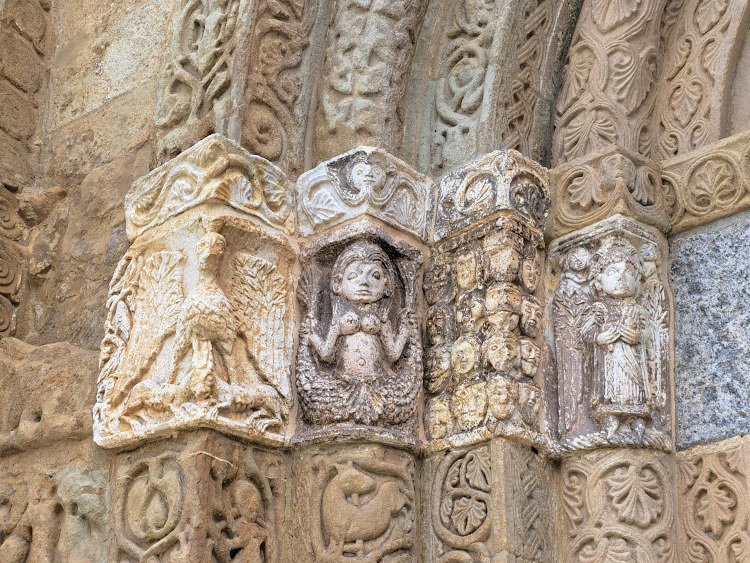
Many of the animals originate from bestiaries, the illustrated manuscripts in which human attributes are transposed onto animals. While the dragon is a metaphor for the devil in John’s Revelation11, the lion has an ambiguous meaning: it can symbolise either Christ the king of Heaven or a ferocious beast, depending on the context of the bas-relief. The eagle, a bird that soars with powerful wings, expresses the heavenly dimension of the Messiah. The earthly and divine natures that coexist in Christ are summarised in the figure of the griffin: a fantastic creature with the head of a bird of prey and the body of a lion. In the bands of the capitals near the portals, hieratic figures of bishops confine monsters and beasts to the outside. Placed there to guard the doors, these figures symbolise the protective power of the Church through its hierarchy.

The side portals and the coronation ceremony
The portal opening onto the northern arm of the transept features a valuable representation of Christ within a clipeus on the lintel, surmounted by two winged angels and the busts of Saints Ennodius and Nicholas. This was the door located along the Via Francigena, which is why the coronation ceremony of the sovereign began in the small square in front of it. It has been hypothesised that the first Lombard basilica of San Michele may have occupied this part of the transept. The public area served to connect the Basilica with the Palatium, in order to welcome the imperial procession.

The procession then entered the building through the portal and attended the enthronement rite, which consisted of a solemn liturgy. The ceremony took place at five circular stones located in the middle of the central nave. During spring, when royal coronations were traditionally held, the light from the apse windows of the presbytery reached that exact point. After the liturgy, the imperial procession left the Basilica on the opposite side of the transept, through the Porta Speciosa. This portal features the theme of the Traditio legis et clavium, in which Christ hands the law to Saint Paul and the keys to Saint Peter. The entrance led directly to the chapel of the Dormitio Virginis.
The mosaics and the labyrinth of the Basilica of San Michele Maggiore in Pavia
The presbytery of San Michele contains the remains of an extraordinary 12th-century mosaic floor. Originally covering the entire area of the presbytery, with a refined iconographic programme, the polychrome and historiated tessellate work appears incomplete today. Only a series of months, the Rex Annus (“King Year”) and the upper portion of a labyrinth are still visible. The fact that what remains of the Pavia presbytery mosaic has survived is due to a fortuitous circumstance. Indeed, it was covered by the large, heavy altar around 1592, which prevented the tiles from coming loose over time.

The San Michele lithostratum represents the highest peak of Pavia mosaic art. It reveals the use of specialized workshops with highly refined and sophisticated techniques. On an upper horizontal band, framed by meanders and other geometric motifs, is the personification of the Year as a sovereign. The king, dressed in a red tunic, is seated on a throne holding a scepter and the globe.
At his sides, under elegant arches, are the Months, identifiable by appropriate inscriptions and the usual agricultural activities. In the representation of January, an old man warms his hands over a fire; in February, a stake is sharpened in preparation for spring; March blows two curved horns; April holds two bouquets of flowers; May weeds the garden; June picks two branches of cherries; July reaps the wheat with a sickle; August is making a wine barrel.

Three panels depicting animals, a dog and two birds, complete the scene still visible today. Just below, we can recognize the outline of a unicursal labyrinth. Fantastical images of a goat riding a wolf and a man riding a goose appear in the corners.
The original work
Fortunately, evidence of the original and complete mosaic composition that covered the presbytery of San Michele has come down to us through a drawing found in the Codice Barberiniano Latino 4426, preserved in the Vatican Library12.

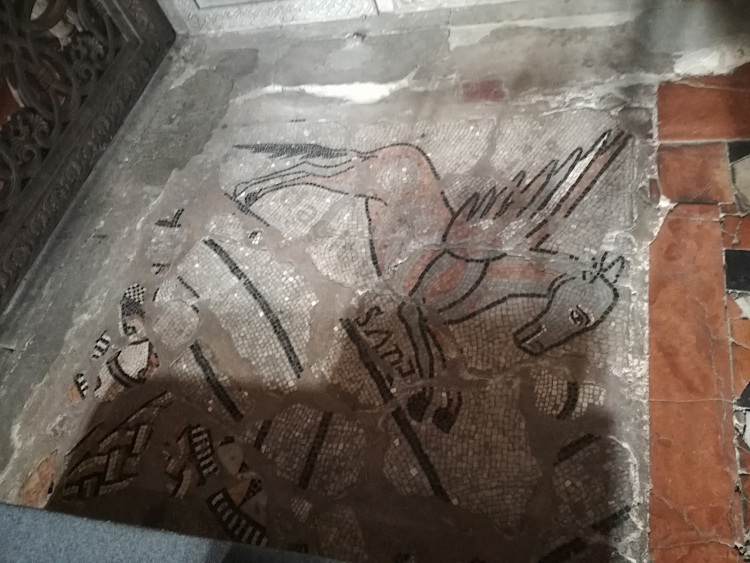
We thus discover that the remaining corners of the central section around the labyrinth were occupied by images of a man fighting a dragon and a winged horse. They could refer to celestial constellations, whose positions mark the different periods of the year and the changing seasons. To the left of the mosaic was a depiction of the fight between David and Goliath. Instead, to the right was a sea, filled with fish.
The labyrinth
The reconstruction highlights the fascinating circular labyrinth, which has eleven circuits arranged within a square measuring approximately 4.4 metres. At the centre of the drawing, we can see the scene of Theseus killing the Minotaur with a sword. An inscription runs all around it:
“Teseus intravit monstrum [que] biforme necavit“.
“Theseus enters the labyrinth and kills the two-formed monster”.
We can understand the reproduction of the myth of Knossos in Pavia in relation to the figure of Michael. Theseus’ victory over the Minotaur is a transposition of the struggle between the Archangel and the devil. However, this interpretation is not sufficient to explain the complexity of this iconographic theme in the Middle Ages, especially when examined not only as a local phenomenon but on a larger scale. In fact, the one in Pavia was not the only labyrinth located in a Christian place of worship. We can find other examples in Chartres Cathedral in France, in Pontremoli, in Lucca Cathedral, in Alatri. Another one, now lost, adorned the Basilica of San Savino in Piacenza.
These works, painted, engraved, or in mosaic form, always unicursal, were found along the pilgrimage routes to Rome and Jerusalem, such as the Via Francigena, on which the Basilica of San Michele Maggiore in Pavia stood. The labyrinth was therefore a metaphor for the long journey to reach the holy cities. At the same time, it symbolised the spiritual and penitential path that pilgrims had to follow in order to attain salvation: an inner maze, made up of renunciation of sin, carnal passions, and material goods, so as to turn their gaze to heaven. Instead, those who chose the labyrinth of the world and its perdition, the domain of the evil Minotaur, were destined to remain trapped there forever.
Samuele Corrente Naso
Notes
- Epistle of Jude, 9. ↩︎
- P. Majocchi, Pavia città regia. Storia e memoria di una capitale altomedievale, Roma, 2008. ↩︎
- Chronicon Novaliciense, 11th century. ↩︎
- The Gesta Berengarii imperatoris does not mention any church in particular. R. Cassanelli, P. Piva, Lombardia romanica, i grandi cantieri, Jaca book, Milano, 2010. ↩︎
- V. Lanzani, La Chiesa pavese nell’alto medioevo: da Ennodio alla caduta del regno longobardo, in Storia di Pavia, II, l’alto medioevo, Pavia, 1987. ↩︎
- Paul the Deacon, Historia Langobardorum. ↩︎
- Otto of Freising, Gesta Friderici I. ↩︎
- P. Majocchi, Papia civitas imperialis. Federico I di Svevia e le tradizioni regie pavesi, in Bollettino della Società Pavese di Storia Patria, n. 105, 2005. ↩︎
- S. Lomartire, La pittura medievale in Lombardia, in La Pittura in Italia. L’Altomedioevo, Milano, 1994. ↩︎
- Odyssey XII, 39-46: “First you will come to the Sirens, who beguile all men who approach them. Whoever, through ignorance, comes near them and hears their voice, that man does not have his wife and little children stand by him and rejoice that he has returned home; instead the Sirens beguile him with their clear-voiced song, as they sit in a meadow, surrounded by a great heap of the bones of mouldering men with their skin shrinking round them”. ↩︎
- Book of Revelation 12. ↩︎
- G. Ciampini, Vetera Monimenta, 1699; Codice Barberiniano Lat. 4426, Biblioteca Vaticana. ↩︎