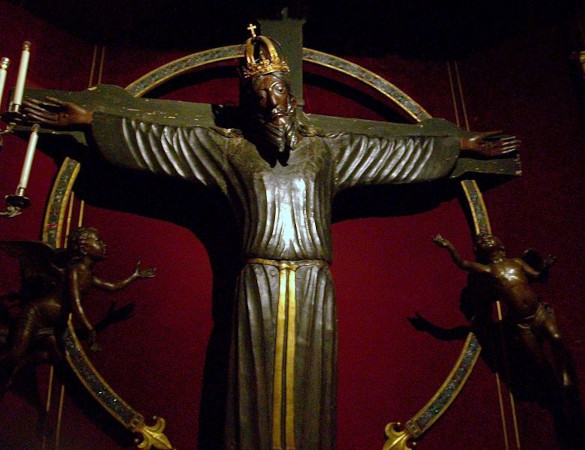
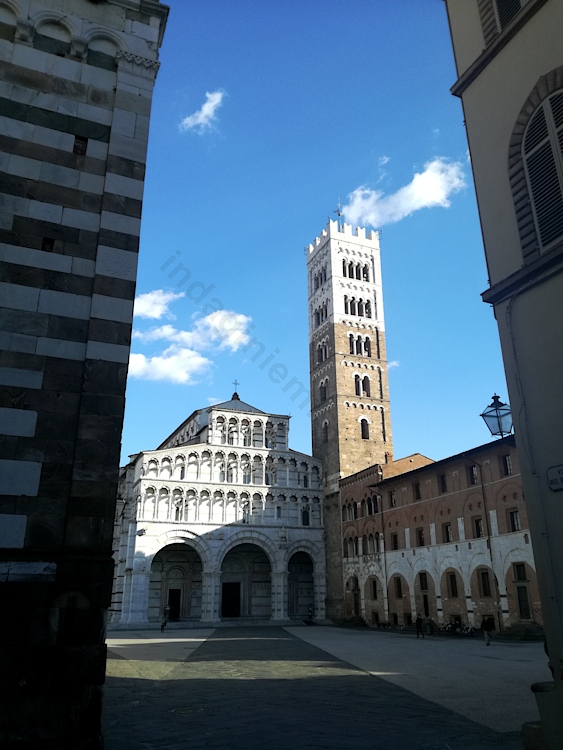
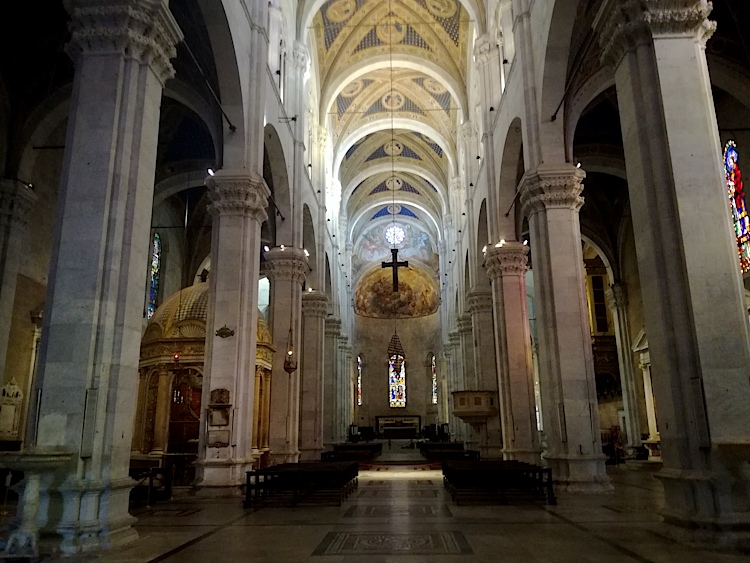
During the Middle Ages, one of the most important and revered relics in Europe was located in Lucca. Kept in the Cathedral of San Martino, the Holy Face was more than just a wooden crucifix for the faithful. According to tradition, it was an acheiropoieta icon, not made by human hand but generated by divine intervention. Now placed inside a Renaissance temple built by Matteo Civitali in 1484, the Holy Face of Lucca would show the true Vultus of Christ on the cross. The relic was the focus of many pilgrimages, especially as it was located along one of the main routes of the Via Francigena, known as the Via del Volto Santo (Holy Face Route).
The Legenda leboiniana
The presence of the miraculous Holy Face in Lucca has been documented since the 11th century. In fact, William II Rufus, King of England from 1087 to 1100, used to invoke the sacred relic in his oaths, saying “per Sanctum Vultum de Luca”2. This valuable testimony reveals that, even at that time, the Holy Face was renowned and revered throughout Europe. Word of mouth from pilgrims travelling along the Via Francigena towards Rome contributed to this.
Instead, it was the canons of Lucca Cathedral who recorded the written form of the Legenda leboiniana. It revealed the supernatural origins of the relic. A 12th century Relatio de revelatione sive inventione ac translatione sacratissimi vultus reported the testimony of a deacon named Leboinus about the events of the Holy Face3. According to the legend, it was Nicodemus, an evangelical figure of the Jewish Sanhedrin, who “having diligently surveyed the form of Christ’s body in size and appearance, and having even fixed its features in his mind, sculpted the most holy face by means not of his own art, but of divine art”4.
The text then reported that, “at the time of Charlemagne and his son Pippin”, the acheiropoietic work was placed on an unarmed boat in Jaffa and left to drift, in order to prevent its destruction by iconoclasts5. The raft reached the coast of Luni, in Liguria, but there was no way to board it. The Holy Face could finally be recovered only thanks to the intervention of the bishop of Lucca, John I. The inhabitants of the two cities disputed the relic until they reached an agreement. The Lunesi got an ampulla containing the Blood of Christ, while Lucca took the Vultus.
The Holy Face of Lucca, a discussed relic
For a long time, scholars wondered why medieval chronicles only ever referred to the Lucca relic as the Holy Face. The sacred relic kept in the Cathedral of San Martino is actually a full-length wooden crucifix. Christ is larger than life-size, has long arms and wears a wavy tunic. The head is turned slightly downwards. The eyes are wide open and “terrible” as Gervasius of Tilbury called them in his 13th century Otia Imperialia6. Some have suggested that the Holy Face referred to in the sources and the crucifix are two different objects, one of which may have been lost. Some also claim that it is merely a 12th-century replica of the original mentioned in the Relatio7. However, scientific tests have refuted these conjectures.
In our opinion, the hagiographic texts themselves reveal the most plausible explanation. As it is the face that constitutes the most sacred part of the sculpture, since no human hands made it, the sources referred to it to indicate the entire crucifix. Only in this way could they emphasise its nature as an “authentic portrait of Christ”. The legend of Leobinus could not express this synecdoche better: just as one recognises the person in its entirety from the face, so the Vultus indicated the Saviour’s entire body8.
The acheiropoieta Vultus
However, such a crucifix was not unique in terms of art, except for the legend surrounding its miraculous creation. Similar artefacts were all over Europe. The legend of the Holy Face allowed to distinguish Lucca effigy from the other cross statues in medieval churches. This primarily responded to the desire of many Christians to get to know the image of the Saviour before contemplating it in Paradise. The relic was also a significant source of wealth for Lucca Cathedral, attracting pilgrims and donations from the faithful.
It is interesting to consider why tradition insists on the acheiropoieta nature of the Holy Face. Hagiographic sources attest that it arrived in Italy in the 8th century from the East. It is not by chance that this period followed the iconoclastic censures ordered by Emperor Leo III the Isaurian. Thus the image of the Lucca Vultus, not being a human-made icon but a true relic, a gift from God to Nicodemus, held a special status that prevented its destruction. The Vultus came to the West where there was a more tolerant religious climate towards sacred representations.
An extraordinary scientific revelation on the origins of the Holy Face of Lucca
To mark the 950th anniversary of the construction of Lucca Cathedral in June 2020, the Opera del Duomo conducted a radiocarbon survey of the Holy Face. The aim was to put an end to the long-standing debate over its dating. The Institute of Nuclear Physics in Florence conducted the diagnostic examination, analysing three wooden fragments and a portion of canvas from the relic9. The tests returned a surprising and extraordinary result. All the samples date back to the 8th–9th centuries. Scientific evidence proves that the Holy Face is not a 12th-century copy, thus confirming the dating in the Legenda Leboiniana. Consequently, we can now assert with confidence that the sacred effigy of Lucca is the oldest surviving wooden sculpture in the West that has survived to this day.
Samuele Corrente Naso
Notes
- Photo by Joanbanjo, CC BY-SA, image. ↩︎
- Eadmerus, Historia novorum, about 1111; William of Malmesbury, Gesta regum Anglorum, IV, 1120, in R. M. Thomson, M. Winterbottom, R.A.B. Mynors, Oxford 1998. ↩︎
- Racconto della realizzazione, scoperta e traslazione del santissimo volto. The legend is reported in many later manuscripts, including the Descriptio qualiter Vultus Domini de Iherosolimi ad civitatem Lucanam sit delatu, ms 110 of the 14th century preserved in the Archivio di Stato di Lucca. ↩︎
- G. Concioni, Contributi alla storia del Volto Santo, Pisa, 2005. ↩︎
- The text gives the date 742 but this is a transcription error; more likely it is 782. ↩︎
- Gervase of Tilbury, Otia Imperialia, 1210-1214. ↩︎
- C. Frugoni, Una proposta per il Volto Santo, in C. Baracchini, M. T. Filieri, Il Volto Santo, storia e culto, Maria Pacini Fazzi, Lucca, 1983. ↩︎
- BCLu, ms 626, c. 2v. ↩︎
- Radiocarbon test results on the INFN site. ↩︎