Among the oldest symbols in the Western religious tradition are Christograms, graphic signs formed by the combination of Greek or Roman letters, which concealed the name of Christ in just a few strokes. Their origins can be traced back to the earliest centuries, when believers, particularly during periods of persecution, were unable to openly profess their faith. Christograms were above all identity symbols for Christian communities. But they were more than that: they constituted a complex visual code capable of conveying theological messages and truths of faith, whose meaning remained obscure to pagans.
The most famous Christogram is undoubtedly the Chi Rho, formed by combining the first two Greek letters of the word “Christ” (Χ and Ρ). According to tradition, this sign appeared to Constantine before the Battle of the Milvian Bridge in AD 312. No less important in Christian symbolism are the IHS trigram, derived from the first three letters of the name “Jesus” (ΙΗΣΟΥΣ), and the ichthys, the fish symbol and acrostic formed from the words “Iēsous Christos, Theou Huios, Sōtēr“, meaning “Jesus Christ, Son of God, Saviour”.

The persecution of Christians
The Holy Scriptures recount that the first persecutions of Christians began in Judaea, in the aftermath of Christ’s death. Christianity was regarded as a heretical movement within Judaism and opposed by the highest religious authorities in Jerusalem. Thus, in AD 34–36, the protomartyr Stephen was stoned to death following a trial before the Sanhedrin1. Furthermore, in AD 44 King Herod Agrippa I had the apostle James the Great executed2.
Despite this, thanks above all to the preaching of Paul of Tarsus, Christianity succeeded in spreading beyond the borders of Palestine, reaching Asia Minor, Greece and, eventually, Rome. The Romans regarded the earliest Christian communities as atheists because they did not worship the pagan gods, but initially tolerated their presence because of their small numbers. However, in AD 64, following the devastating fire that destroyed Rome, the Emperor Nero identified the Christians as convenient scapegoats. Accused of having started the blaze3, many of them began to be sentenced to death in public spectacles of torture. According to tradition, the victims of this first great persecution included the apostles Peter and Paul themselves4.
“And to those condemned to death were added further outrages: covered with the skins of wild beasts, they were torn apart by dogs, or fastened to crosses, or burned, so that, when daylight had failed, they might serve as nocturnal illumination”.
Tacitus, Annales, XV, 44.4. Translation by the author5.

The “number of the beast”
Nero undertook an almost total reconstruction of Rome and, between the Palatine and Esquiline Hills, had the Domus Aurea built. The vestibule of this vast and sumptuous private residence was dominated by the Colossus. The bronze statue more than thirty metres high, created by Zenodorus, depicted Nero in the guise of the Sun god. Legend has it that the emperor forced Christians to prostrate themselves before this enormous sculpture. It is more plausible that Nero is the figure referred to in the famous passage from Revelation concerning the “number of the beast”, 666:
“The second beast was given power to give breath to the image of the first beast, so that the image could speak and cause all who refused to worship the image to be killed. It also forced all people, great and small, rich and poor, free and slave, to receive a mark on their right hands or on their foreheads, so that they could not buy or sell unless they had the mark, which is the name of the beast or the number of its name. This calls for wisdom. Let the person who has insight calculate the number of the beast, for it is the number of a man. That number is 666″.
Revelation 13:15-18.
In gematria, an interpretive system that assigns a numerical value to Hebrew letters, the sum of the letters in the name “Nero Caesar” (נרון קסר, NRWN QSR) does indeed produce exactly 666, since N=50, R=200, W=6, N=50, Q=100, S=60 and R=200. Some ancient manuscripts also contain the variant 6166, corresponding possibly to the emperor’s name in Latin: Nero (NRW QSR)7.
Later persecutions
The persecution of Christians in the Roman Empire continued sporadically until the 3rd century. It was only from the reign of the Emperor Decius that the oppression became more systematic8. In AD 250, he issued an edict requiring all citizens to perform public sacrifices to the gods. These could obtain in exchange a libellus, a written certificate attesting to their adherence to the Roman religion. The persecution was resumed under Valerian, who in AD 257 ordered all bishops, priests and deacons to practise pagan worship. Moreover, he prohibited religious gatherings on pain of death9. The final and most severe persecution of Christians in the Roman Empire, however, took place during the reign of Diocletian. It began in AD 303 with a series of edicts ordering, among other things, the destruction of churches and sacred texts, the confiscation of ecclesiastical property and the removal of Christians from public office10.

Symbols and Christograms
Amid widespread hostility and pagan ostracism, Christians were forced to adopt strategies of survival and concealment. Worship could not be conducted openly or in recognisable public buildings. Services were therefore held in private houses, known as domus ecclesiae. The catacombs, hidden from view, served as underground cemeteries. Messages of faith also had to be conveyed secretly, preferably in a cryptic form comprehensible only to the initiated.
It was for this purpose that the rich symbolism of early Christianity emerged and developed. It was a visual code that drew upon images from the pagan repertoire while assigning them new and secret meanings. Thus, the Good Shepherd carrying a lamb on his shoulders echoed the classical iconography of the god Hermes Kriophoros. The anchor became a symbol of hope and a metaphor for the cross. The dove and the peacock alluded to eternal salvation, while the vine represented the Eucharist. Alongside these symbols were the Christograms and acrostics, which concealed the holy name of Christ.
The Chi Rho
One of the principal Christograms, in use as early as the 3rd century, was the Chi Rho, also known as the Chrismon or Monogram of Christ. The symbol consists of a combination of X (chi) and Ρ (rho) superimposed on one another, corresponding to the first two letters of the Greek word Χριστός (Christòs), meaning “Messiah”.

The Chi Rho was often accompanied by the Greek letters alpha and omega. Christ, as God, is the beginning and the end of all things.
“I am the Alpha and the Omega, says the Lord God, who is, and who was, and who is to come, the Almighty”.
Revelation 1:8.
The Ichthys
Another widespread sign within the coded language of early Christianity was the Ichthys, an acrostic derived from the Greek ΙΧΘΥΣ, meaning “fish”, whose letters formed the phrase “Iēsous Christos, Theou Huios, Sōtēr“, that is, “Jesus Christ, Son of God, Saviour”. The faithful associated this inscription with the symbol of a stylised fish, created from two intersecting arcs. It resembled the representation of the vesica piscis.
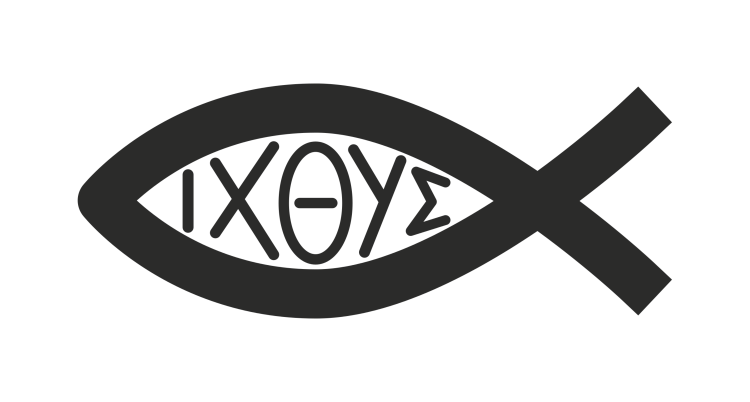
The Christian association with the fish symbol has its roots in several episodes recounted in the Gospels. Christ called his first disciples, including Peter and Andrew, to become “fishers of men”12. It was on the basis of this metaphor that, at the end of the 2nd century, Tertullian compared Christians to little fish (pisciculi) born in the waters of baptism:
“But we, little fishes, following the example of our ΙΧΘΥΣ, Jesus Christ, are born in the water, and we cannot be saved except by remaining in the water”.
Tertullian, De Baptismo, I, 3, c. AD 200. Translation by the author13.
The ichthys symbol could be depicted on votive lamps, funerary inscriptions and the walls of the catacombs, as a sign of belonging to the Christian community.
The IHS trigram
The IHS trigram emerged in the 3rd century as a nomen sacrum used in Greek manuscripts of the New Testament. It consisted of the first three letters of the Greek name for Jesus, ΙΗΣΟΥΣ (Iēsous): iota (Ι), eta (Η), sigma (Σ). The nomina sacra were conventions through which scribes abbreviated, in contracted form, names they considered particularly sacred. This practice served a dual purpose: on the one hand, a practical one, as it saved space and ink; on the other, a theological one, as it emphasised the importance of the particular term.
In this sign, be victorious! Christograms and Constantine’s conversion
The persecution of Christians began to come to an end with Galerius’s Edict of Toleration in 311. He acknowledged the failure of the repressive policies adopted by his predecessors. Just two years later, in 313, Licinius and Constantine issued the famous Edict of Milan. This act established freedom of worship for Christians throughout the Roman Empire. According to Eusebius of Caesarea, Constantine converted on the eve of the Battle of the Milvian Bridge, which he won against Maxentius in 312, thanks to a divine sign:
“At midday, as the sun was beginning to set, he affirmed that he had seen with his own eyes a cross-shaped sign of light in the sky, positioned above the sun, bearing this inscription: ‘In this, be victorious! (Εν Τουτω Νικα)‘”14.
Eusebius of Caesarea, Life of Constantine, Book I, 28. Translation by the author.
According to Lactantius, however, before the decisive battle the emperor had a “caeleste signum Dei” placed on his soldiers’ shields, perhaps representing the Chi Rho Christogram15.
“Constantine was instructed in a dream to mark the heavenly sign of God on the shields and thus engage in battle. He did as he was commanded, marking Christ on the shields with an X crossed by a letter I with a curved top. Armed with this sign, the army went into battle“16.
Lactantius, De mortibus persecutorum, 44, 4–5. Translation by the author.

Christograms after the spread of Christianity
Thanks to their simplicity and profound theological significance, Christograms remained in use for many centuries, even after the end of the Christian persecutions. From Late Antiquity onwards, these symbols began to appear on religious buildings, liturgical objects, and even on imperial coins. The Chi Rho, for example, acquired a public and official use following Constantine’s conversion, becoming an emblem of Christian rulers. The IHS trigram, on the other hand, enjoyed particular success from the Late Middle Ages onwards, thanks above all to the preaching of Saint Bernardino of Siena, who, in the 15th century, promoted its dissemination as a symbol of the Most Holy Name of Jesus. During the Counter-Reformation, it was adopted by the Society of Jesus founded by Saint Ignatius of Loyola and placed at the centre of a radiant disc surmounted by a cross.
Samuele Corrente Naso
Notes
- Acts of the Apostles 6:8-8:1. ↩︎
- Acts of the Apostles 12:1-2. ↩︎
- Tacitus, Annals, XV, 44.1-5. ↩︎
- Lactantius, De mortibus persecutorum, 2.4-6. ↩︎
- “Et pereuntibus addita ludibria, ut ferarum tergis contecti laniatu canum interirent, aut crucibus adfixi aut flammandi, atque ubi defecisset dies in usum nocturni luminis urerentur“. ↩︎
- For example, in the Codex Ephraemi Rescriptus, Bibliothèque Nationale de France 9, Gregory-Aland no. C (or 04), 5th century. ↩︎
- F. De Luca, Apocalisse: la soluzione dell’enigma, Guida, Napoli, 2013. ↩︎
- Eusebius of Caesarea, Ecclesiastical History, Book VI, Chapter 39.4. ↩︎
- Eusebius of Caesarea, Ecclesiastical History, Book VII, Chapters 10-13. ↩︎
- Lactantius, De mortibus persecutorum, 12. ↩︎
- Image by Justin Benttinen, CC BY-SA 4.0. Link to the original image. ↩︎
- Gospel of Luke 5:10. ↩︎
- “Sed nos pisciculi secundum IXΥΘN nostrum Iesum Christum in aqua nascimur nec aliter quam in aqua permanendo salvi sumus“. ↩︎
- “Horis diei meridianis, solem in occasum vergente, crucis tropaeum in coelo ex luce conflatum, soli superpositum, ipsis hoculis se vidisse affirmavit, cum hujusmodi inscriptione: Hac vince“. ↩︎
- Lactantius, De mortibus persecutorum, 44. ↩︎
- “Commonitus est in quiete Constantinus ut caeleste signum Dei notaret in scutis atque ita proelium committeret. Facit ut iussus est et tranversa X littera summo capite circumflexo, Christum in scutis notat. Quo signo armatus exercitus capit ferrum“. ↩︎