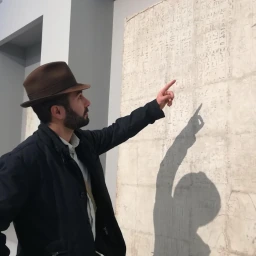
In the medieval period, Porto Torres still preserved the historical legacy of its past. The city had once been the prosperous Roman colony of Turris Libisonis, which tradition attributes to Julius Caesar’s foundation in 46 BC. In antiquity, the city developed into a flourishing maritime and commercial harbour. Its importance is attested both by the writings of Pliny the Elder1 and by the splendid mosaics of Ostia Antica bearing the inscription of the Navicularii Turritani. Even after the fall of the Western Roman Empire, Turris retained considerable prestige, becoming the capital of the Judicate of Torres-Logudoro2. Furthermore, it established itself as the main religious centre of northern Sardinia thanks to its ancient archiepiscopal see, founded as early as the 3rd century.
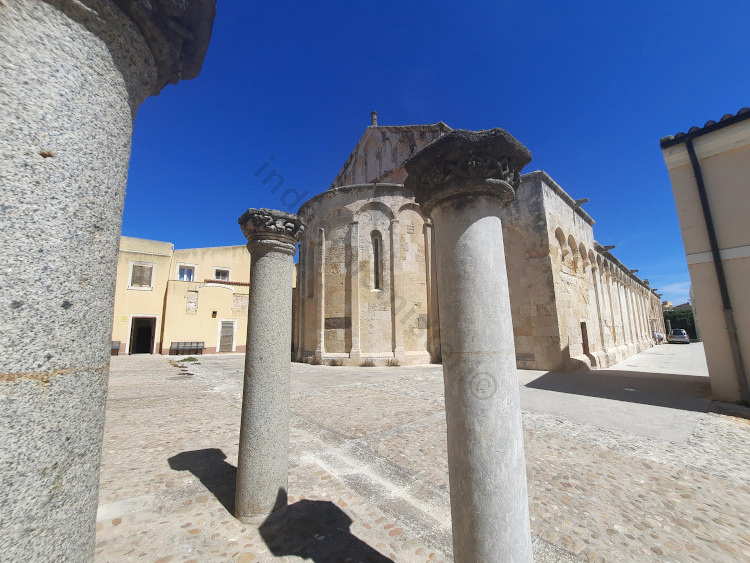
The Basilica of Saint Gavino
At least two other churches had existed on Monte Angellu in Porto Torres before the present Basilica of Saint Gavino3. Dating the remains of these earlier structures is difficult. Indeed, only archaeological traces of both buildings survive, now largely incorporated into and covered by the medieval masonry. The basilica dedicated to Saints Proto, Gianuario and Gavino, who were martyred during the persecution of Diocletian (AD 303), was built between the final decades of the 11th century and the beginning of the following one, during the height of the Sardinian Judicate period4.
The earliest documentary references to the church are found in the Condaghe di San Pietro in Silki5. The text, written between 1063 and 1182, mentions a certain Ithoccor Manata as an armentariu. This figure was the administrator of the assets of the basilica of Saint Gavino. The richest source of information concerning the construction of the building is, however, the Condaghe della fondazione e consacrazione della basilica di San Gavino di Torres, known to us through a 17th-century copy6, but probably based on an original version dating from the end of the 15th century. It reveals that the basilica was commissioned by Judge Gonnario Comita7. He entrusted its construction to craftsmen from Pisa: “feghit venner XI Mastros de pedra, et de muru sos plus fines, et megius qui potuerunt acatare in Pisas, et posit ad operare sa ecclesia“8.
Saint Gavino and Gonnario Comita
According to tradition, Gonnario Comita decided to build a church in honour of Saint Gavino after the martyr appeared to him in a dream, promising him recovery from the serious illness that afflicted him, provided that he found his relics and those of Proto and Gianuario, and granted them a worthy burial. The Judike accepted the request and discovered the bodies of the three martyrs near the present-day church of Balai, where they had suffered martyrdom. He then had them transferred to the newly founded basilica.
“Et istande malaidu Iudighe Comida, li fuit reveladu unu die dae Santu Gavinu, intro de sa camara sua. Et clamaitilu narrande: ‘Comida, Comida, pesa et vae ad Portu du Turres, ad unu logu qui si clamat Monte Agellu, et icui fraigha una ecclesia in nomen de Deu et de sos sanctos martires, sos quales sunt sepelidos in Balai, et aen a nomen sos ditos santos Gavuinu, Prothu et Ianuariu’”9.
Francesco Rocca, Historia muy antigua, llamada el Condaghe o Fundaghe: de la fundacion, Consecracion e Indulgencias del Milagroso Templo de Nuestros Illustriss. Martyres y Patronos S. Gavino, S. Proto y S. Januario en lengua sarda antigua, Sassari, 1620.
The construction works continued during the judicate of Torchitorio Barisone de Lacon-Gunale, son of Gonnario Comita. The basilica was finally consecrated no later than 1082, under Archbishop Constantine of Castra10. In the 15th century, it underwent extensive alterations that introduced elements typical of the Catalan Gothic style, as attested by an inscription dated 1492.
The exterior of the Basilica of Saint Gavino
The Basilica of Saint Gavino displays exceptional structural features. These are unique not only in Sardinian Romanesque tradition but also in the wider context of Italian medieval architecture. Three naves, ending in two opposing apses, divided its extensive plan, measuring fifty-eight metres in length and nineteen metres in width. Scholars have attributed this unusual configuration both to the presence of earlier architectural remains discovered at the site, which may have influenced the building’s layout, and to the multiple liturgical functions that the church was designed to fulfil, as it served simultaneously as a cathedral and a martyrion, a sanctuary dedicated to the preservation and veneration of martyrs’ relics.
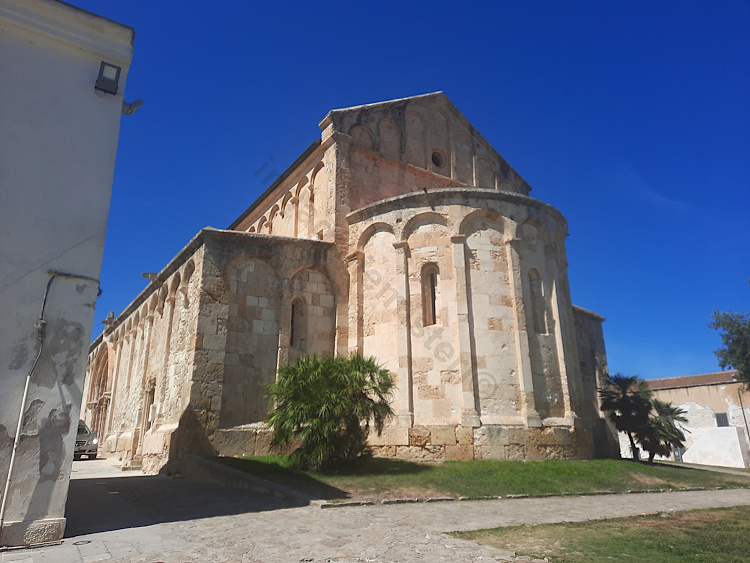
The central nave rises higher than the lateral ones. This feature is already visible from the exterior, particularly from the areas of the Atrio Comita and the Atrio Metropoli. The basilica also lacks a true main façade. Access is instead provided through the portals opened along the sides of the building. The builders used limestone from the Nurra region for the entire structure, with large squared blocks arranged in regular courses forming the wall facings. Pilasters and hanging arches define the exterior perimeter. Their rhythm gives the architectural decoration a sense of balance and sobriety. The ornamental scheme is deliberately restrained, although originally the eastern apse was embellished with several ceramic basins of Islamic inspiration, following a decorative motif widespread in Romanesque architecture and also found, for example, on the façade of the Abbey of Pomposa.
The portals
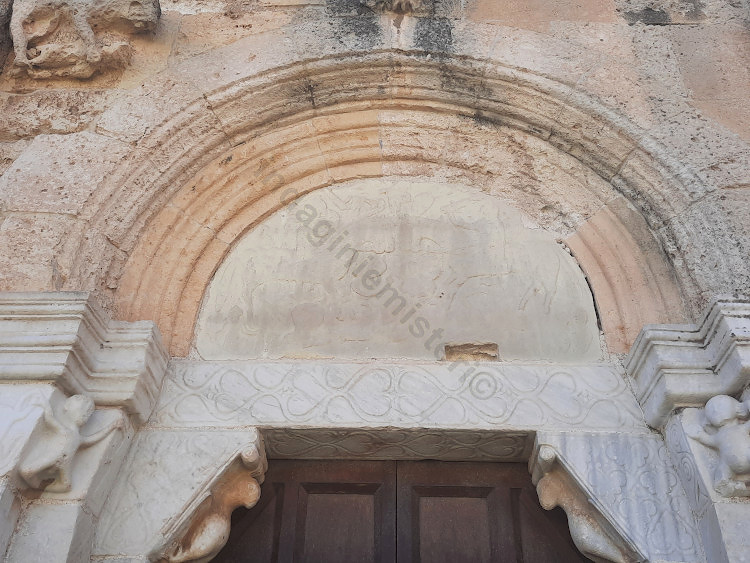
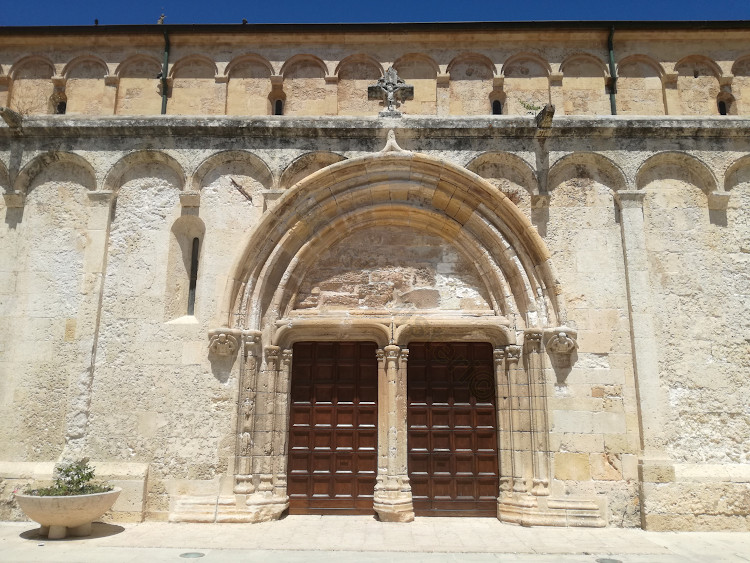
On the northern side is the main portal, surmounted by a carved lunette. Here we can find almost all of the basilica’s sculptural decoration. The capitals of the jambs house zoomorphic and anthropomorphic figures. Rosettes and foliate scroll decorations surround a bird and a beast. A naked man and woman represent Adam and Eve, while also symbolising the sins of the flesh. The architrave, carved with vine shoots, a symbol of regeneration, and two confronted eagles, supports the lunette, which displays a chivalric scene. This may perhaps refer to the Balearic campaign against the Moors (1114–1115). The knight depicted is probably Saltaro, remembered in the 12th-century Liber maiolichinus de gestis pisanorum illustribus as the godson of Constantine I, Judge of Torres. A feline protome also appears on the corbel of the blind arches. A lion seizes a man on a stone block to the left of the portal.
The southern side displays simpler forms and a single large splayed twin portal. This Gothic-Catalan addition dates from the Aragonese period. The portal consists of two openings surmounted by a round arch supported by slender columns. The arch moulding rests on capitals carved with figures of angels, each holding a heraldic shield.
The interior
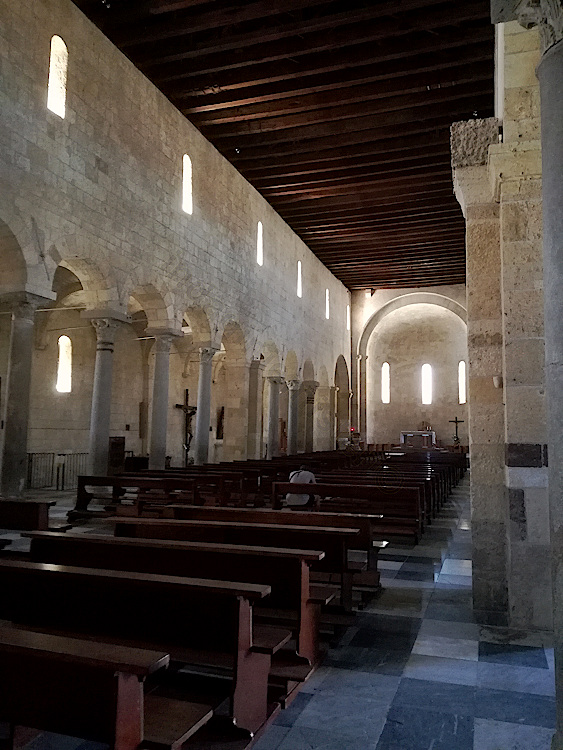
The interior of the basilica follows a rectangular plan. The three naves are divided by fourteen supports on each side. These consist of eleven reused columns from the ancient Roman Turris Libisonis, surmounted by capitals, and three cruciform pillars. The three apsidal single-light windows feature simple or, in some cases, stepped splays. The clerestory contains sixteen further windows with similar characteristics. Through these openings, a soft and subdued light filters into the interior, creating an atmosphere of harmony and contemplation. A timber roof structure with trusses spans the central nave. Instead, groin vaults, articulated by transverse arches, cover the fifteen bays of the side aisles. The high altar, in the Gothic-Catalan style, is located in the south-western apse. The opposite apse houses a 17th-century wooden catafalque with polychrome statues of the three Christian martyrs Gavino, Proto and Gianuario.
Crypt and ante-crypt
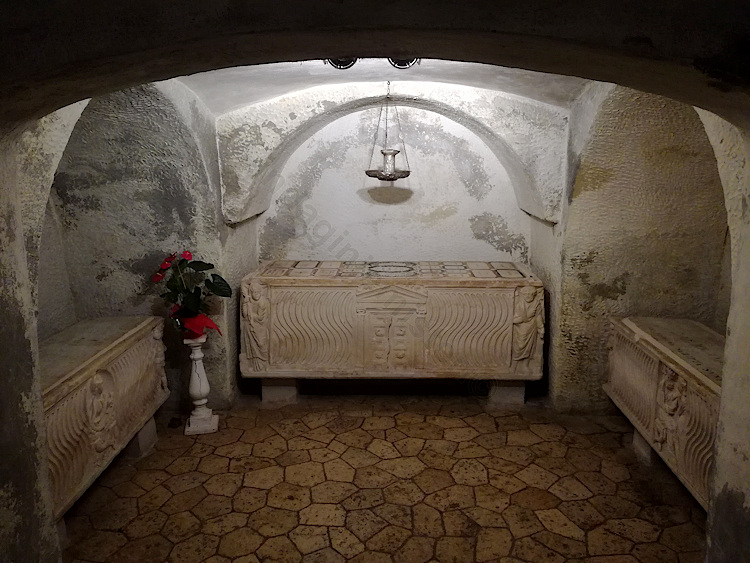
The ante-crypt, built according to the principles of Renaissance classicism, contains numerous niches intended to house statues of local martyrs. The crypt proper, located beneath the high altar, is instead the result of a 17th-century rebuilding. It houses the remains of the Turritan martyrs Gavino, Proto and Gianuario, preserved in three Roman-era sarcophagi. The basilica’s underground structure preserved the remains of a 5th–7th-century martyrion. Tradition places its construction on the site of Saint Gavino’s burial.
The cult of Saint Gavino and the Turritan martyrs
An early mention of the cult devoted to the martyrs of Porto Torres is found in the Hieronymian Martyrology, an anonymous work composed in the 5th century11. Here, Gavinus is commemorated in Turribus on 25 October, while it lists Proto and Gianuario on the 27th. The text, however, provides no information regarding the earthly lives of the martyrs. Their story is instead found in two distinct medieval hagiographical sources: the 12th-century Passio sanctorum martyrum Gavini, Proti et Ianuarii12 and the following century’s Inventio corporum sanctorum martyrum Gavini, Proti et Ianuarii13.
The hagiographical sources date the martyrs’ story to Diocletian’s persecutions in the early 4th century. They also relate that Gavino – perhaps originally from Gabium in Latium – was a Roman soldier, while Proto held the role of bishop and Gianuario that of deacon. According to the hagiographical account, the three saints were martyred near the coast of Balai, in the area of Porto Torres, on the orders of the governor Barbarus, an imperial official who was said to have been entrusted with jurisdiction over the provinces of Sardinia and Corsica.
“The Roman governor Barbarus asked: ‘Where do these men come from, what is their faith, and in which God do they place their trust, that they should stand here with such boldness and serene faces?’. The holy martyrs Proto and Gianuario replied: ‘If you ask about our lineage, we were born in Sardinia and raised in Porto Torres; if you ask about our faith, we are Christians […]’. The governor said: ‘Have you heard that an edict has been issued by the Roman emperors, ordering that Christians must either be compelled to sacrifice to idols or be put to death by the sword?’”
From the Passio sanctorum martyrum Gavini, Proti et Ianuarii, translation by the author.
The martyrdom of the Turritan saints
According to the Passio, faced with the declaration of faith made by Proto and Gianuario, Barbarus decided to send Proto into exile on the island called Cornicularia. He kept Gianuario with him instead, in an attempt to make him change his mind. However, as the two Christians remained steadfast in their convictions, Barbarus eventually entrusted them to a soldier named Gavino, ordering him to take them to prison.
During the journey to the prison, Gavino heard Proto and Gianuario chanting a psalm: “We lift up our eyes towards the mountains, from where our help comes; our help comes from the Lord, who made heaven and earth“. Struck by their words and enlightened by the Holy Spirit, the soldier converted to the Christian faith. Thus, he decided to set them free. Proto and Gianuario then found refuge in secluded places. However, the following day, Barbarus ordered his soldiers to bring the two Christians before him once again. Instead, it was Gavino who appeared before the governor:
“O governor, for the salvation of your life, do not judge them to be wicked, for if you knew them you would know them to be righteous and most holy. For they are servants of the Almighty God, creator of heaven and earth, and therefore I could not keep them. For I too confess Him, I worship, bless and glorify the same God; and for His love, if necessary, may I be ready for death […]”.
From the Passio sanctorum martyrum Gavini, Proti et Ianuarii, translation by the author.
Gavino was then sentenced to death. Then, according to the account of the Passio, he was beheaded in a cave near Balai. However, “the Almighty God wished to show great wonders through him“, and therefore Gavino’s spirit went to the place where Proto and Gianuario had taken refuge and urged them to “receive the glory of victory“. Thus, the two saints presented themselves before Barbarus, ready to face martyrdom: “with joyful faces they kissed one another, and were struck down by the sword.”
Samuele Corrente Naso
Notes
- Pliny, Naturalis Historia, III, 7, 85. ↩︎
- The Judicates were autonomous political entities that emerged in Sardinia during the 9th century. Four Judicates shaped the island’s political landscape until the 15th century: Torres-Logudoro, Gallura, Arborea and Cagliari. Each was governed by a Judex and had its own political and administrative structure. ↩︎
- L. E. Pani, F. Manconi, Indagini archeologiche nel complesso di S. Gavino a Porto Torres: scavi 1989-2003, Pontificia accademia romana di archeologia, 2006. ↩︎
- C. Nonne, San Gavino di Porto Torres: il circolo delle relazioni formali, in La basilica di San Gavino a Porto Torres. Teorie a confronto, Atti del convegno di studi, Porto Torres, Sala Gonario 21 dicembre 2008, Ghezzano (PI), Felici Editore, 2010. ↩︎
- The Condaghe was an administrative document used in Sardinia between the 11th and 13th centuries, during the Byzantine and Judicate periods. Originally created to record acts of donation in favour of an ecclesiastical institution, its function was gradually extended over time, becoming a register of landed property and assets. The Condaghe di San Pietro in Silki contains records relating to the possessions owned by the churches and monasteries within the surrounding area of the Benedictine abbey of Silki. It is preserved in the University Library of Sassari. ↩︎
- G. Meloni, Il condaghe di san Gavino, CUEC Editrice, Cagliari, 2005. Conservato presso la Biblioteca universitaria di Cagliari (S. P. 6. 9. 25). L’edizione visionata è quella di Francesco Rocca, Historia muy antigua, llamada el Condaghe o Fundaghe: de la fundacion, Consecracion e Indulgencias del Milagroso Templo de Nuestros Illustriss. Martyres y Patronos S. Gavino, S. Proto y S. Januario en lengua sarda antigua, Sassari, 1620. ↩︎
- Judex of Torres and Arborea. ↩︎
- “He had eleven master stoneworkers and builders come, the finest and most skilled that could be found in Pisa, and he set them to work on the church“. ↩︎
- “And this ailing Judge Comita, one day, received a revelation from Saint Gavino inside his chamber. And he called to him, saying: ‘Comita, Comita, rise and go to Porto Torres, to a place called Monte Agellu, and there build a church in the name of God and of the holy martyrs, who are buried at Balai and whose names are the aforementioned saints Gavino, Proto and Gianuario’”. ↩︎
- G. Meloni, Il condaghe di san Gavino. ↩︎
- H. Delehaye, Commentarius perpetuus in Martyrologium Hieronynianum ad recensionem H. Quentin, in Acta Sanctorum XXIV, Novembre 11, II, Bruxelles, 1931. ↩︎
- G. Zichi, Passio Sanctorum Martyrum Gavini Proti et Ianuarii, testo latino a cura di G. Zichi, Versione italiana di K. Accardo, Sassari 1989. Two codices, both originating from the Cistercian Abbey of Clairvaux, are preserved in the Library of the Faculty of Medicine of Montpellier. ↩︎
- B. R. Morzo, La passione dei Santi Gavino, Proto e Gianuario, in Studi cagliaritani di Storia e Filologia, Cagliari 1927. This is the ninth lesson (Lectio IX) of the Office In sanctorum martyrum Gavini, Proti et Ianuarii from an incunabulum preserved in the Municipal Library of Sassari. ↩︎